Thursday, October 31, 2013
Instructional Video: Canoeing by Reg Blomfield
This is a fantastic video from the mid-1930's demonstrating some amazing paddling skills. Toward the end there is a shot that is hard to imagine being taken with the technology that pre-dated GoPros by about 70 years. Whoever paddles near me when I'm solo in an empty canoe better be ready to duck because I'm going to be trying out the "technique" demonstrated at 10 minutes in!


Tuesday, October 01, 2013
Wednesday, May 15, 2013
Near-Real Time Satellite Imagery
I love this site: http://earthdata.nasa.gov/data/near-real-time-data/rapid-response/modis-subsets
From there, I can keep an eye on fun things like ice-out & freeze up, monitor forest fires, check snow cover, and more. All with images that are as little as a couple of hours old.
To find the images relevant for my area (central Saskatchewan), I choose the North America subset, then roll my mouse over the images to find the ones I want, usually "Waskesiu" (covers from Lake Diefenbaker in the south to north of the Churchill River, and extending well into Manitoba to the east and Alberta to the west) or "Bratts Lake" if I'm interested in areas to the south, or "Thompson" if I'm interested in areas to the north.
From there you can choose the resolution you want, and the type of image you want. They offer several types of images which are probably very meaningful to those that know how to interpret them, but I normally stick to the True Colour images. You can also turn on layers to show fires, borders, and coasts. This is helpful to position the image with points of reference you are familiar with. You can also download the image into Google Earth which makes pinpointing less-obvious locations very easy.
Due to those pesky clouds, you may not be able to see a given area on the specific date, but you can scroll through the days to find a nice clear view.
For those who paddle the far north, this is a great way to keep an eye on whether your float plane will be able to land or not. For the rest of us, it's fun to check it out and dream of trips.
The image from yesterday, a warm day with lots of cumulonimbus, is shown below (head to the website for much better resolution, but don't expect to be able to peer into anyone's back yard).

Less than hour after I posted the above, I find another way to view the same thing, and it's pretty awesome: http://earthdata.nasa.gov/labs/worldview/
From there, I can keep an eye on fun things like ice-out & freeze up, monitor forest fires, check snow cover, and more. All with images that are as little as a couple of hours old.
To find the images relevant for my area (central Saskatchewan), I choose the North America subset, then roll my mouse over the images to find the ones I want, usually "Waskesiu" (covers from Lake Diefenbaker in the south to north of the Churchill River, and extending well into Manitoba to the east and Alberta to the west) or "Bratts Lake" if I'm interested in areas to the south, or "Thompson" if I'm interested in areas to the north.
From there you can choose the resolution you want, and the type of image you want. They offer several types of images which are probably very meaningful to those that know how to interpret them, but I normally stick to the True Colour images. You can also turn on layers to show fires, borders, and coasts. This is helpful to position the image with points of reference you are familiar with. You can also download the image into Google Earth which makes pinpointing less-obvious locations very easy.
Due to those pesky clouds, you may not be able to see a given area on the specific date, but you can scroll through the days to find a nice clear view.
For those who paddle the far north, this is a great way to keep an eye on whether your float plane will be able to land or not. For the rest of us, it's fun to check it out and dream of trips.
The image from yesterday, a warm day with lots of cumulonimbus, is shown below (head to the website for much better resolution, but don't expect to be able to peer into anyone's back yard).
Less than hour after I posted the above, I find another way to view the same thing, and it's pretty awesome: http://earthdata.nasa.gov/labs/worldview/
Saturday, May 04, 2013
Codette Lake Ice Surge
This was filmed by the Saskatchewan Water Security Agency (formerly Sask Watershed Authority) on Codette Lake, about 250 km northeast of here. Unbelievable.
Friday, May 03, 2013
Chris Hadfield & Music Monday
I'm a science guy and I love music, so this is pretty awesome.
(p.s. Chris Hadfield is a paddler, and it was his brother's stove plans that I used when we built ours a few years ago. Chris & Dave have been referred to in this blog a few times over the years.)
(p.s. Chris Hadfield is a paddler, and it was his brother's stove plans that I used when we built ours a few years ago. Chris & Dave have been referred to in this blog a few times over the years.)
Thursday, April 25, 2013
Strange Micro-Climate Around Fort Mac?
I was having a look at satellite photos to check on the snow melt in the prairies and wondering if the Saskatchewan Rivers were opening up. Indeed, the North Saskatchewan River seems to be opening up. All of the prairies are covered in snow with the exception of southern Alberta and southwestern Saskatchewan. Then I noticed a peculiar dark patch surrounding Fort McMurray. It seems that this one spot in northern Alberta has also had it's snow melted, or the snow is dark in colour. It just happens that the area closely corresponds to the bitumen sands (aka tar sands) and the oil processing facilities there. Go figure.
The image above is a cropped view of the satellite image (find the original at http://lance-modis.eosdis.nasa.gov/imagery/subsets/?subset=AERONET_Fort_McMurray.2013114.terra.250m) from yesterday viewed via Google Earth. The river heading south to north is the Athabasca River and the Clearwater River joins at Fort McMurray flowing west out of Saskatchewan. The brown area amounts to about 90 km north and south, and about 35 km east and west.
By the way, the above effect is not simply due to urbanization. The larger cities of Edmonton & Saskatoon look much more white than the area around Fort Mac.
 |
| Daily satellite image from 24/04/2013 viewed as a Google Earth overlay. The dark region is in stark contrast to the white of the remainder of northern Alberta and Saskatchewan. |
By the way, the above effect is not simply due to urbanization. The larger cities of Edmonton & Saskatoon look much more white than the area around Fort Mac.
Monday, April 15, 2013
11 Year Old Rolling Her Kayak
This video is from the fellow Paddle Canada sea kayak instructors at SKILS, Sea Kayak Leadership Instruction, a great company out of BC (Michael of SKILS was my co-instructor-trainer for my instructor course). Since the kid in the video is nearly the same age as my older daughter, I find this video pretty awesome. Time to rent some pool time for the family!
Thursday, February 28, 2013
Summer Dreaming
Here's a summer photo for a wintry morning. I love this photo of my daughters, it captures their characters well (one in a pretty little dress while fishing, the other in practical camping clothes).
 |
| The kids, fishing on Echo Island, Amisk Lake, Saskatchewan. |
Tuesday, February 19, 2013
Friday, February 01, 2013
"Running" Otter Rapids
Today over on our Northstar Expeditions blog I posted a series of photos showing myself and +Jay running Otter Rapids (Churchill River, northern Saskatchewan) in 2007. It's an awesome series of photos taken from shore and really shows the fun to be had in Otter.
 |
| No, we haven't sunk in this photo (yet), we're merely in the trough between waves. Head to the full post to see the rest of the photos and learn the outcome of these brave adventurers. |
Wednesday, November 07, 2012
A Damn Shame
This is a bloody shame and to me is wrong in so many ways.
What we SHOULD be doing, is encouraging more people to utilize the parks in the winter, not discourageing them. We are becoming fatter, lazier, and more out of touch with the real world and these cuts are a huge step backward. I am so disappointed.
This is a blow to those of us that enjoy the outdoors in winter without the noise and smell of an engine, it's a blow to society as a whole in terms of physical fitness, mental health, and connection to the natural world, and it's a blow to the business owners who benefit from having such fantastic skiiing (literally) on their doorstep.
CBC Sask: National parks cut cross-country ski trail workCuts mean end to ski trails at Prince Albert National Park and Riding Mountain National Park
http://www.cbc.ca/news/canada/saskatchewan/story/2012/11/06/sk-cross-country-ski-trails-national-parks-121106.html"One of the services we've reduced or cut back on or ended for this year is the track setting for the ski trails," Alan Fehr, the park superintendent for Prince Albert National Park, told CBC News Tuesday. "And some of the backcountry camping services, we've cut those as well."I love Prince Albert National Park in the winter. It's quiet and the ski and snowshoe trails are super. Snowmobiles are not allowed, so it is one of VERY FEW places in Saskatchewan where we can ski and be assured of not encountering a skidoo on the trail, or have a skidoo or quad wrecking the tracks.
What we SHOULD be doing, is encouraging more people to utilize the parks in the winter, not discourageing them. We are becoming fatter, lazier, and more out of touch with the real world and these cuts are a huge step backward. I am so disappointed.
This is a blow to those of us that enjoy the outdoors in winter without the noise and smell of an engine, it's a blow to society as a whole in terms of physical fitness, mental health, and connection to the natural world, and it's a blow to the business owners who benefit from having such fantastic skiiing (literally) on their doorstep.
Wednesday, September 12, 2012
Weather: Frontal Analysis & More
Maybe it's the farm background, maybe it's biking to work each day, but I try to pay attention to the weather. I like trying to figure it out (though I usually can't), and I like looking at what's going on. Here's another tool in my quiver that I learned about this week from "nootka" on the West Coast Paddler forums.
You can find a variety of information at http://weather.unisys.com and it's pretty neat stuff.
This shows the fronts, where they are currently, and where they were for the past 12 hours.The image below should show the current fonts. (Or go to http://weather.unisys.com/surface/sfc_fronts.php?inv=0&t=cur to see it on the Unisys website.)
Of course when you look at this it will all be different, but currently there is a giant cold front that has been sweeping across North America for a few days now. Yesterday, it brought very high winds to the prairies (it's still windy today, but not quite so bad) that blew my father and brother's crops away, very literally. It's amazing how quickly a good crop can go from good to nearly gone in a few hours.
Here's another map that shows the surface data: http://weather.unisys.com/surface/sfc_map.php?inv=0&t=cur®ion=wc - by going to the link you can select your region, the type of map, & the information it shows.
There is a fair bit more at the website to explore and I've only just started poking around the http://weather.unisys.com website.
You can find a variety of information at http://weather.unisys.com and it's pretty neat stuff.
This shows the fronts, where they are currently, and where they were for the past 12 hours.The image below should show the current fonts. (Or go to http://weather.unisys.com/surface/sfc_fronts.php?inv=0&t=cur to see it on the Unisys website.)
 |
| Current frontal positions in North America. Image source comes from http://weather.unisys.com/surface/sfc_fronts.php?inv=0&t=cur. |
Here's another map that shows the surface data: http://weather.unisys.com/surface/sfc_map.php?inv=0&t=cur®ion=wc - by going to the link you can select your region, the type of map, & the information it shows.
 |
| Surface data with Canada selected as the region. Image comes from http://weather.unisys.com/surface/sfc_map.php?inv=0&t=cur®ion=wc. |
Tuesday, September 11, 2012
Paddling Stuff For Sale
Reduced Prices!
It's nearly the end of the paddling season and I have some of my gear to sell off. In particular, I have a few paddles and a spray skirt to sell. If you are interested in any of the below, give me a call at 306-370-3462, or leave a comment (I'll receive your comment via email quickly). Prices listed do not include shipping. If you are not local and want to get a quote on shipping, let me know where you are and we'll get a quote from FedEx and Canada Post.The paddles are Adventure Technology (AT) straight-shaft paddles. I have one with glass blades and 3 available with carbon fiber (graphite) blades. All of these paddles feature AT's "Synapse Ferrule" that allows the blade feather angle to be set in 15° increments from 0° to 60° (right or left) to find the perfect angle for you.


Quest Paddles (3) - 210 cm, 210 cm, 220 cm
The carbon fibre paddles are the "Quest" model and are new this summer (mid-season). I have 2 Quest paddles for sale that are 210 cm and one that is 220 cm. These paddles retail for $230 locally. I am asking $150 for the unused 210 cm paddle, and $125 for the slightly used 210 cm and 220 cm paddles, all are in excellent condition. These are excellent good quality paddles that won't break the bank. My own pictures of these Quest paddles are below, as well as a description and specs from the AT Paddles website.The Quest Carbon features a lightweight carbon construction and Full Control Grip on the shaft. The unique blade design is ideal for low angle paddling but is versatile enough for varying conditions and paddling styles because of its soft dihedral blade. In addition, the blade features a uniquely high fiber-to-resin ratio making it one of the most durable blades available anywhere.
- Weight: 29.5 oz/ 836 g
- Shaft: Carbon Fiberglass Blend, Standard Diameter
- Ferrule: Synapse Ferrule with SmartSet Technology
- Blade: 623 sq cm; Low Angle Design; Carbon; Reflective Logo

 |
| Unused paddle, still with the original tag and rubber band that they came from the store with. |


 |
| Synapse Ferrule is a spring loaded mechanism that allows the paddler to pull the joint apart and adjust the paddle feather in 15° increments. (I prefer 45° myself.) |
Odyssey Paddle (1) - 220 cm
The glass paddle is the "Odyssey" model and is 220cm, was purchased at the start of last year and has seen 2 seasons of use in paddling lessons. It's in good condition. This paddle retails for $132 and I am asking for $70. This is a good paddle that is a great savings over the much more expensive graphite paddles. The length at 220 cm is good for the average to tall person, paddling a kayak that is narrow to moderate width kayak (up to about 25", wider than that and you probably should look for a longer paddle). Again, the graphic, description and specs are from the AT website, the photos are my own.The Odyssey Glass features a fiberglass shaft construction in both Full Control Grip and straight shaft. Its slightly larger blade is designed for more power without adding flutter. A great choice for those seeking easier rolling, additional stability, and better grip in the water.
- Weight: 38.0 oz/ 1077 g
- Shaft: Fiberglass, Standard Diameter
- Ferrule: Synapse Ferrule with SmartSet Technology
- Blade: 695 sq cm; Oversize Blade; Fiberglass

 |
| Assembled paddle with feather angle set to 45°. |
 |
| Top blade on the right shows the power face of the blade while the bottom blade on the left shows the backside of the blade. |
 |
| I even have the original tag for this paddle! |
Harmony Spray Skirt (1) - Large
I have a Harmony neoprene and nylon spray skirt for sale. This was my primary personal skirt last season before I upgraded to an all-neoprene (more watertight) skirt. It features nylon tunnel for comfort, and a deck perimeter made of neoprene to allow it to stretch and fit a variety of boats. It has two pockets in the deck, perfect for a few survival items (in case you wash up on shore without your boat), a small waterproof camera, or some snacks. Velcro at the waist allows you to adjust the skirt to fit your waist. This skirt retails for around $100 and I am asking $40. The condition is OK, there's definitely some wear and tear from rescue practice and use (see the photos). |
| Shown on a Swift Saranac with a 16.5 x 31" cockpit. This skirt also fits my WS Tempest 180 Pro with a 20" x 36" cockpit, though it's pretty tough to get on. I would suggest a cockpit of 35" or less is better for this skirt. |

 |
| The joint at the back of the rand is starting to come loose. Repair with a stitching awl may be necessary. |
Thursday, September 06, 2012
Wildlife - For Jitka and Hanka
We recently held a large family reunion and were visited by distant relatives from the Czech Republic (Jitka & her daughter, Hanka). Afterwards, Jitka expressed disappointment that she did not encounter more wildlife while in Canada, expecting to see large animals in a more prominent fashion. Hanka even had to write a report about the plants and animals she saw in Canada, but had to leave out the animal portion. There must be a perception that if you come to Canada you will see wildlife roaming freely and abundantly when the reality is that encountering wildlife is an uncommon event that causes me to count myself lucky when it occurs. It is a special moment when I see a moose on a canoe trip.
Here is a list of some animals that are possible to see while paddling in this part of Canada (Saskatchewan). I've excluded birds, fish, rodents (except the biggest rodents) and other small critters from the list because the list would get far too long and complex. It is in approximately descending order with the animals I'm most likely to see at the top.
Here is a list of some animals that are possible to see while paddling in this part of Canada (Saskatchewan). I've excluded birds, fish, rodents (except the biggest rodents) and other small critters from the list because the list would get far too long and complex. It is in approximately descending order with the animals I'm most likely to see at the top.
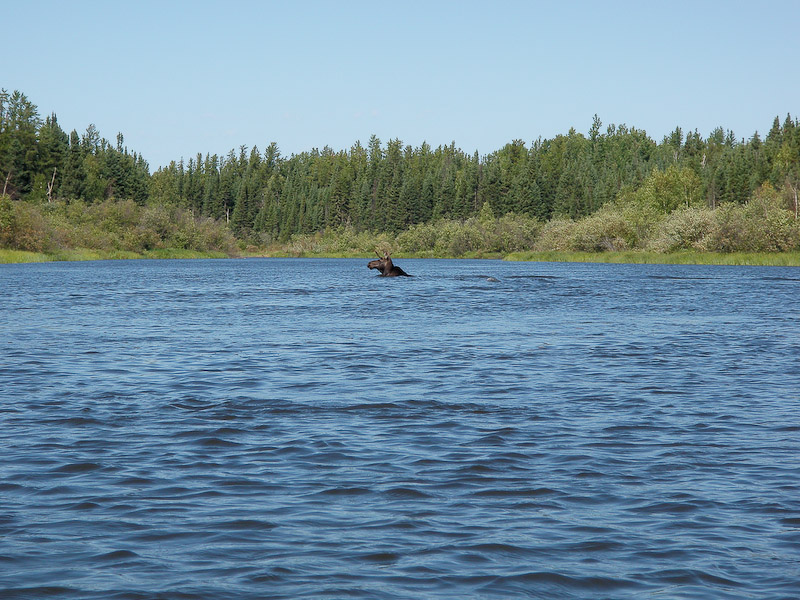 |
| Moose swimming across the Montreal River. Photo by Rob Kunz. |
- Beaver. I see beaver almost every time I paddle. Not only do I see them when paddling, we also hear the loud "kapuch" of their tail at night.
- Snowshoe Hare. Rabbit stew, anyone?
- Moose. The largest member of the deer family, I've seen these about 4 times now while paddling (twice in Prince Albert National Park, once on the Montreal River, once while paddling the South Saskatchewan River). In recent years moose have gotten much more common in the farming areas of southern Saskatchewan.
- Garter Snake. My kids have taken to searching the forest floor for garter snakes to catch.
- Fox.
- White Tailed Deer. Deer (white tail, then mule deer) would be at the top of the list except that this list has a paddling focus, and most of the northern places I paddle don't have many deer. The odds of seeing them when paddling the South Saskatchewan River are fairly high.
- River Otter. Otters are pretty cool to see. I've seen them in Prince Albert National Park and in 2010 we saw some on the Churchill River. In the winter I've seen their sliding tracks in the snow.
- Porcupine. Porcupine are all over, and in theory I should see lots of them, but I don't unless you count the dead ones on the side of the road. I know they are up in the trees and I often look for them, but only very rarely do I see them.
- Mink, Ermine, Weasel, Fisher. I'm lumping these members of the weasel family together, they are the smallest members of this list.
- Coyote. We often hear these at night, especially when paddling the South or North Saskatchewan Rivers.
- Raccoon. We have lots of them and I know they are around because I see their tracks in the mud, but I've never seen a raccoon on a paddling trip. I've seen hundreds of them dead at the side of the road.
- Woodchuck/Groundhog. We saw one in 2010 while canoeing on the Churchill River. My friend Mark claims they are quite common and he often sees them on the drive north. I never have.
- Black Bear. I've seen one once while paddling in BC, and many times driving. My most recdent bear encounter was a young animal that came to check out the messy smelly fish fry last month at the in-law's cabin at Candle Lake just as we were starting into supper. I chased it off making lots of noice and banging a 2x4 against the tree it scampered up into.
- Elk. What is it about elk and national parks? In Banff, Jasper and Waskesiu you will see them wandering the town streets. My odds of seeing them when paddling are not so high, but much better than some other animals.
- Lynx. I heard a lynx once while hiking, but have never seen one. The sound was very disturbing. More common than most people know, they are good at avoiding being seen.
- Wolf. Again, Prince Albert National Park is the likeliest place to see these elusive creatures, perhaps while on a snowshoe trip. The only wolf I have seen in the "wild" was walking down the middle of the road in PANP and was sick and perhaps starving.
- Cougar. There are more of these around than we would ever realise, they pass silently leaving little trace, and give a wide berth to humans.
- Buffalo. There are some places in Prince Albert National Park (and area) where it would be possible to see free-roaming wild buffalo (bison).
- Woodland Caribou. We have them, but the herds are small and during the paddling season tend to be farther north. They aren't coping well with human activities in the north.
- Badger. Wide ranging with large territories and rarely seen.
- Wolverine. Cousin to the badger and largest member of the weasel family. Wide ranging solitary animals with massive territories, these animals avoid humans and don't cope well with disturbances in their habitat.
- Grizzly Bear. 120 years ago there were large herds of buffalo that roamed the prairies of USA and Canada, and many animals followed these herds. The Plains Grizzly was one of the animals that lived off of the buffalo and followed the massive herds. After settlers came the buffalo were hunted and removed from the prairies, and the animals that relied on those herds disappeared. The Grizzly Bears of the Alberta foothills are the last remnants of the Plains Grizzly population. It is still possible, but quite unlikely, to see Grizzly in the northernmost regions of our province, but it is likely a stray animal that wandered south from the Tundra rather than wandering east from the foothills. (On a related note, a Polar Bear was once seen swimming in the far northeast part of Saskatchewan. It was a young male that was starving.)
 |
| Finding signs of the animals is much easier than seeing the animals themselves. These are otter tracks on MacKay Lake in the snow on a very cold day. The otter runs a couple of steps, slides on it's belly, then pushes itself with it's hind feet while sliding on it's belly. |
 |
| The more common way to see moose lately, a recent photo by my father in the fields near the family farm. |
Friday, August 17, 2012
Adaptive Paddling
This summer I had the privilege of paddling with a fellow that is a c5-6 quadriplegic. It was a 2 hour parent + kid class and he was there along with his wife and daughter. I surely learned more that day from that family than they did for me. I look forward to continuing that learning for both of us and hope that we get to paddle together again.
He had a kayak that was adapted with a seat and outriggers much like the one that is shown in this video. In addition, he had special connectors that connected his hands (wrists, actually) to the paddle. He mentioned that the new connectors he was using were a great improvement over what he used to do, which was to duct tape his hands to the paddle.
The video, featuring a paraplegic paddler and his adapted cedar-strip kayak is very inspiring.
Enjoy!
He had a kayak that was adapted with a seat and outriggers much like the one that is shown in this video. In addition, he had special connectors that connected his hands (wrists, actually) to the paddle. He mentioned that the new connectors he was using were a great improvement over what he used to do, which was to duct tape his hands to the paddle.
The video, featuring a paraplegic paddler and his adapted cedar-strip kayak is very inspiring.
Enjoy!
Subscribe to:
Posts (Atom)