An unusual weather pattern settled over the prairies last week. In the wake of the much-hyped "polar vortex" that brought very cold temperatures to much of the USA (i.e. the jet stream pushed cold northern air southward - sounds like "winter"), we had a week of unseasonably warm weather. With the warm winter air, comes the wind. Mid week we even had winds of up to 110 km/hr here in Saskatoon. As a result, although I had wanted to take advantage of the warmth and get out on the water earlier, I was unable to do so until the dying hours of the system (work and family life were also major factors). So, with the wind blowing about 30 km/hr from the west, I went down to the river on Sunday morning to check the conditions. Happily, the river bank created a lee blocking the wind, the conditions on the west bank of the river were calm and beautiful. Home I went to grab my kayak and paddling gear and returned to the river to get out for a short paddle.
The paddle was indeed short - my GPS tells me that I was moving for just over 45 minutes - as we had other family activities happening that day and my wife needed the car. But, a short paddle is much nicer than no paddle at all.
It was 1.6°C at launch according to Environment Canada. I launched from the west side of the South Saskatchewan River at the boathouse in Victoria Park because it afforded me good access to the river and parking. Transporting the kayak to the water had never been easier, simply sliding the boat along in the snow. Launching was OK, the docks are out at this time of year (though a piece remains this winter) and the river bottom here is muddy due to the silt that the water treatment plant just upriver dumps back into the river (an iron-rich clay that the plant filters out of our river). I chose not to launch at the piece of dock due to a large tree branch caught up under and beyond the dock. However, I was able to get in from the bank easy enough without bringing a bunch of the orange clay mud on board.
Taking a break in the eddy to get a couple of photos.
Looks like I really need to stretch the neck gasket on the drysuit!
With the low angle sun, the snow and water, it was REALLY bright. I must remember to bring sunglasses next time.
The open channel in the river sticks to the west shore and that shore was ice free meaning egress was possible to the west bank anywhere that I paddled. The open channel is fairly narrow from the boathouse and upriver to beyond the water treatment plant, so the current was relatively strong through this stretch. I was able to paddle upriver at about 3 - 4 km/hr. I paddled upriver about 35 minutes until my allotted time was nearly up, then turned with the river and headed downstream. Now going at speeds of up to 13 km/hr, I was back at the boathouse in just a few minutes, so continued downstream toward downtown Saskatoon, before once again turning back toward the boathouse.
The ice pushed up this large chunk, 1.5 m or so tall.
Heading downriver toward the city centre.
Happy paddler!
Strange tracks in the snow.
It was a short paddle and a beautiful day on the river. Clearly, it was so short that any sensible person wouldn't even have bothered. I'm glad I did.
GPS track overlayed on Google Earth satellite imagery. I have drawn in the approximate ice cover as a translucent white shape (I only drew it as far as the Idylwyld Bridge, though it does continue downriver to the weir). Upriver on this map is toward the bottom left corner.
I posted recently about our family's trip to Florida and getting out for a paddle on the ocean while there (see Winter Paddling, Part 1 here). The next day, I got out on the water again, this time with the rest of the family.
Based on a recommendation on LinkedIn, I booked a tour for my family through A Day Away Kayak Tours operating out of Titusville. We chose the "Mondo Combo Refuge tour", a tour in Indian River Lagoon at the Merrit Island National Wildlife Refuge that starts off in the afternoon and goes into the evening. The tour promises wildlife & bioluminescence. Offering a sampling of a few items, it sounded like a good fit for the family.
It took us longer to get to the launch than I anticipated, due to being more accustomed to open prairie driving, finding a giant geocache(store), a protracted pee break at McDonald's, and a stop to allow a sailboat pass under a draw bridge. When we arrived at the launch we were a bit late but our guide didn't seem too bothered (we had touched base via phone en route). It turns out we were the only ones on the tour - we were getting a private tour!
Almost to the launch, waiting for a sailboat to pass under the draw bridge.
At our launch near Haulover Canal. We paddled tandem open-cockpit kayaks, one adult and one kid per kayak. I usually prefer something a little more sleek.
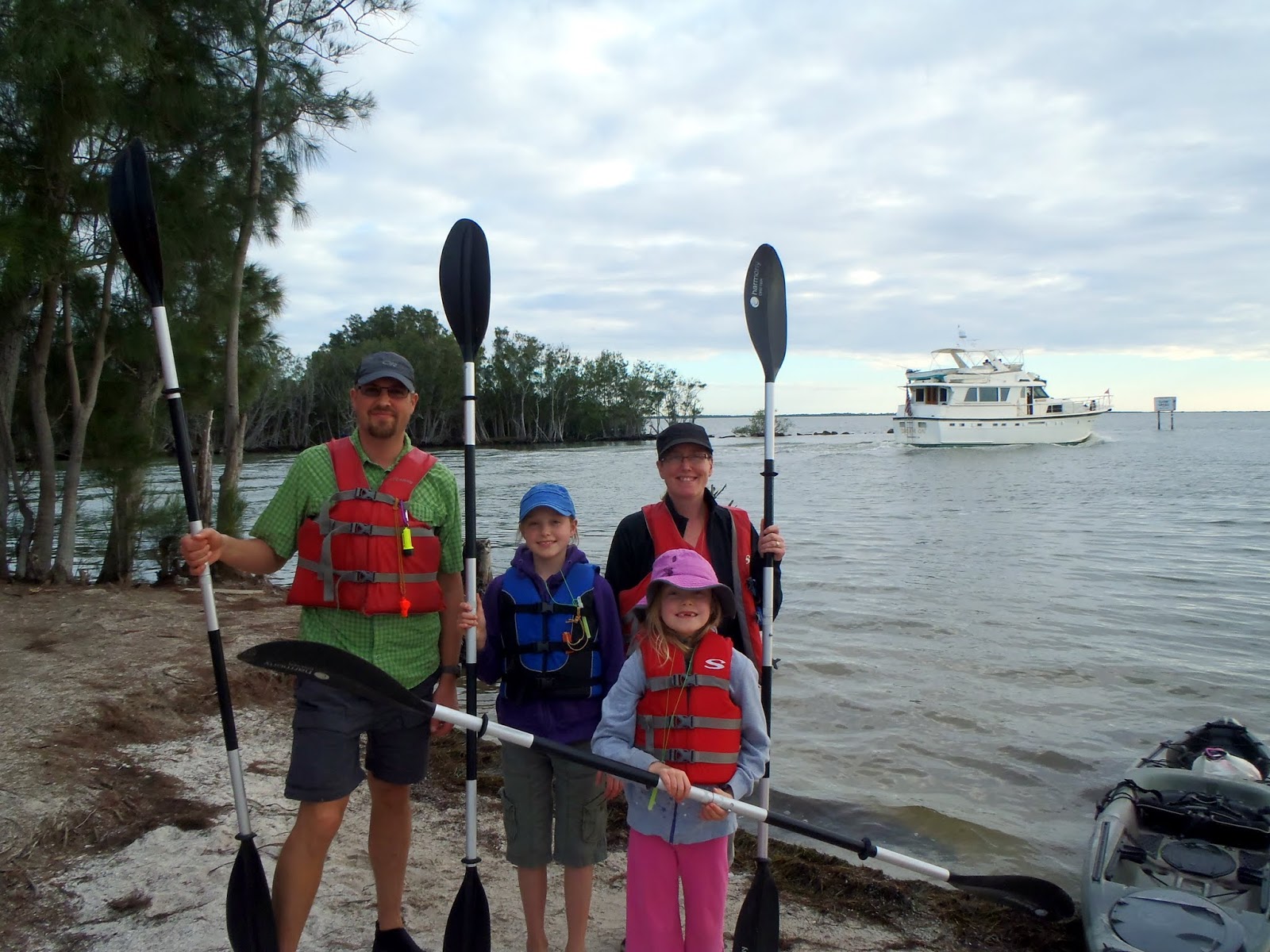
Pre-paddle family portrait. The boat behind would just have come through Haulover Canal and under the drawbridge pictured earlier.
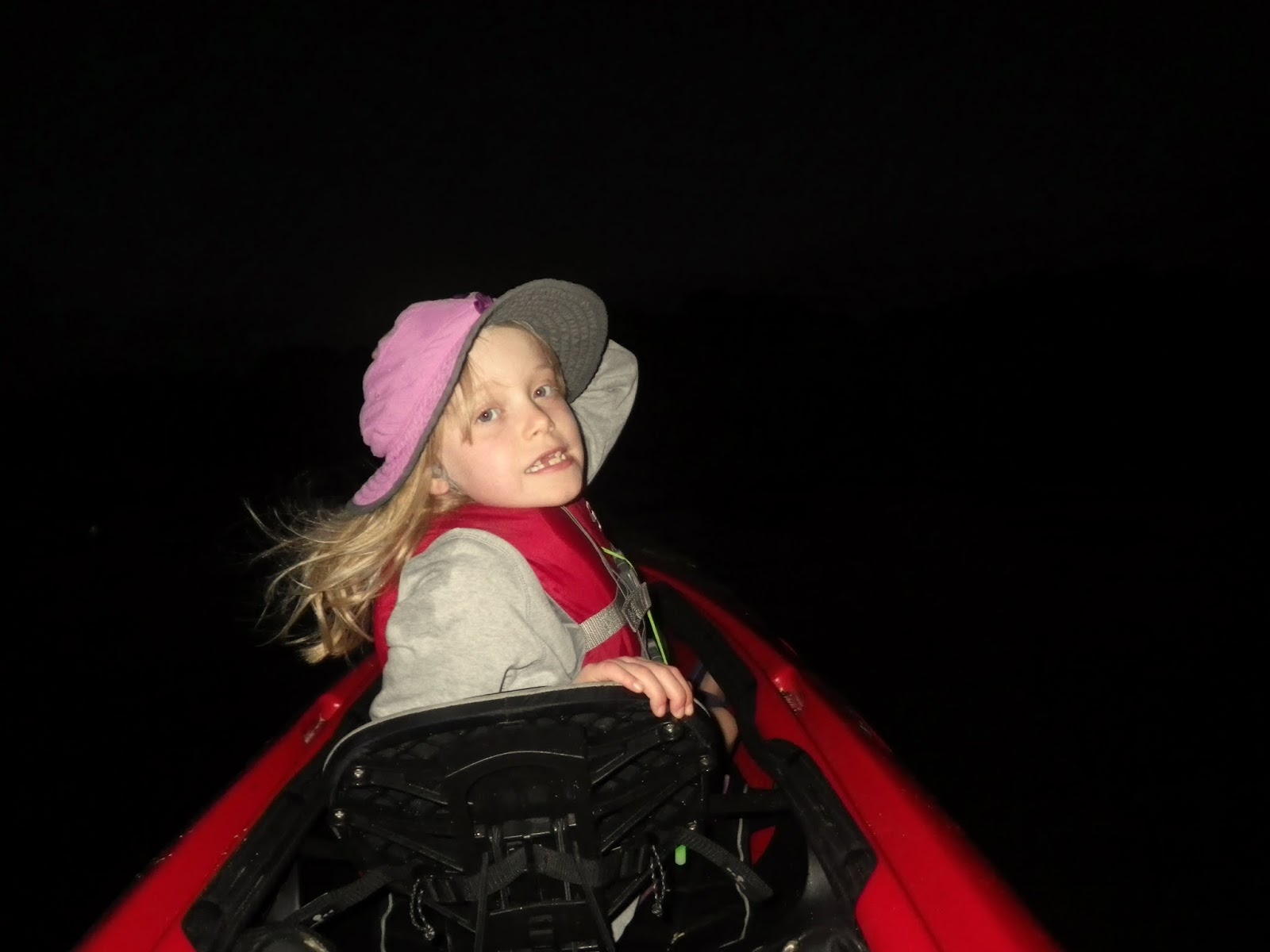
Kid 1
Kid 2
Strange plant life (mangroves) growing out of the brackish water.
A fellow on shore was throwing a net to catch bait fish.
Hauling in his catch.
My wife was VERY cool to the idea of encountering alligators while paddling. She got used to it pretty quickly with the reassurance of our guide, Tim. Kid 2, however, was not so happy.
Checking out an alligator from a few feet away.
Osprey.
Woodpecker holes in the palm tree stumps.
You can see me on the right taking advantage of the high performance characteristics of the Pamlico 135T by carving a beautiful edged turn. Of course that's a joke. The thing doesn't really carve an edged turn at all.
This must be where our herons come to spend their winter. Like all the birds we saw in Florida, they were much less afraid of us than they seem to be at home.
Sunset approaching in the lagoon and watching for manatees.
We saw the ripples and nostrils that were the evidence of a couple of very large beasts below us. Two manatees swam below our kayaks then surfaced some about 30' away. Although we couldn't see much of them due to the murky water of the lagoon, it was a very neat experience.
Another heron.
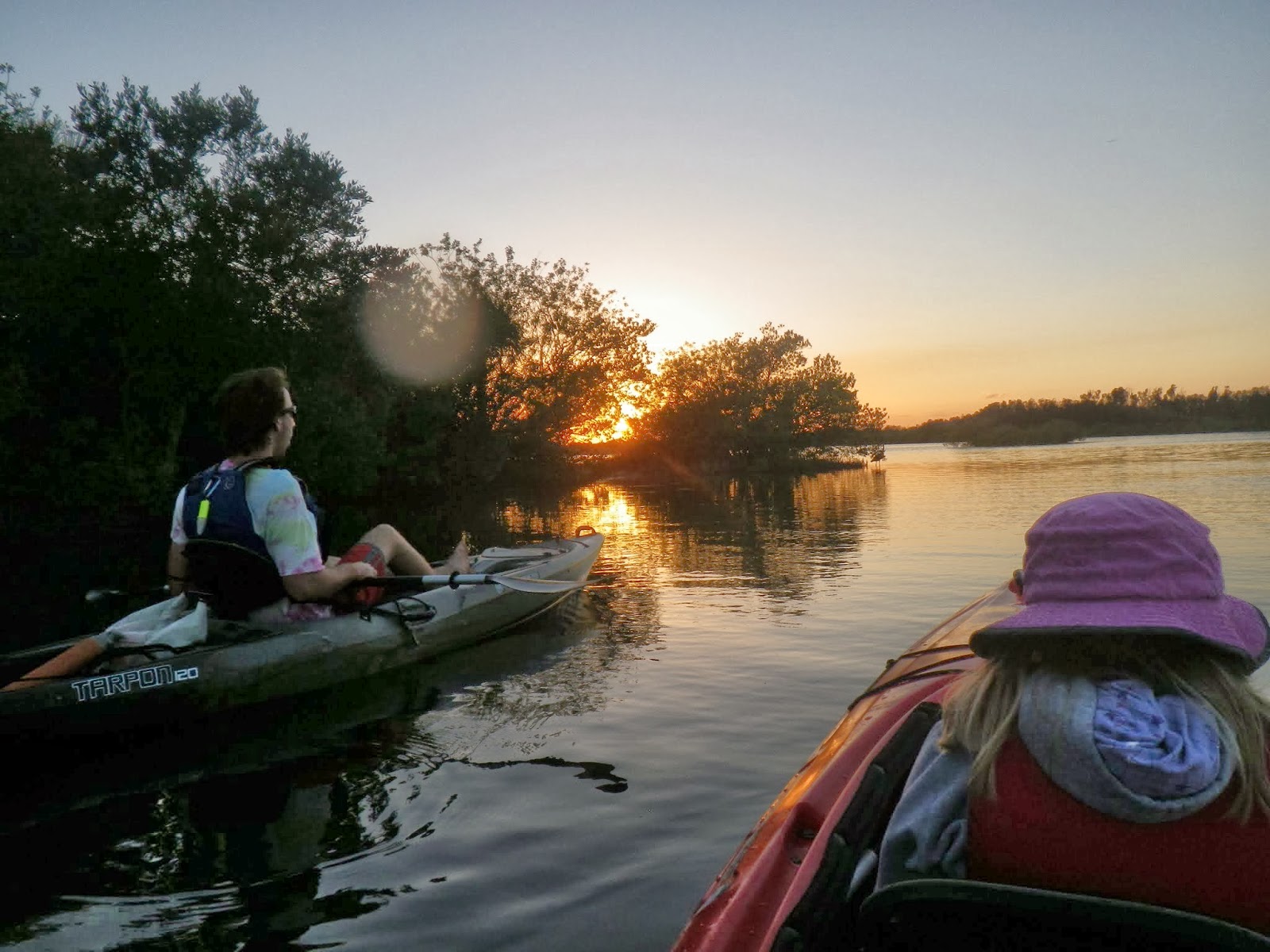
Sunset over Indian River Lagoon.
Tim certainly had a relaxed approach.
Family portrait on Indian River Lagoon.
Just after sunset we saw two dolphins, a mother and calf. The light is too poor to get a good photo, but we really enjoyed seeing the pair swimming nearby. The adult seemed to be shepherding the calf.
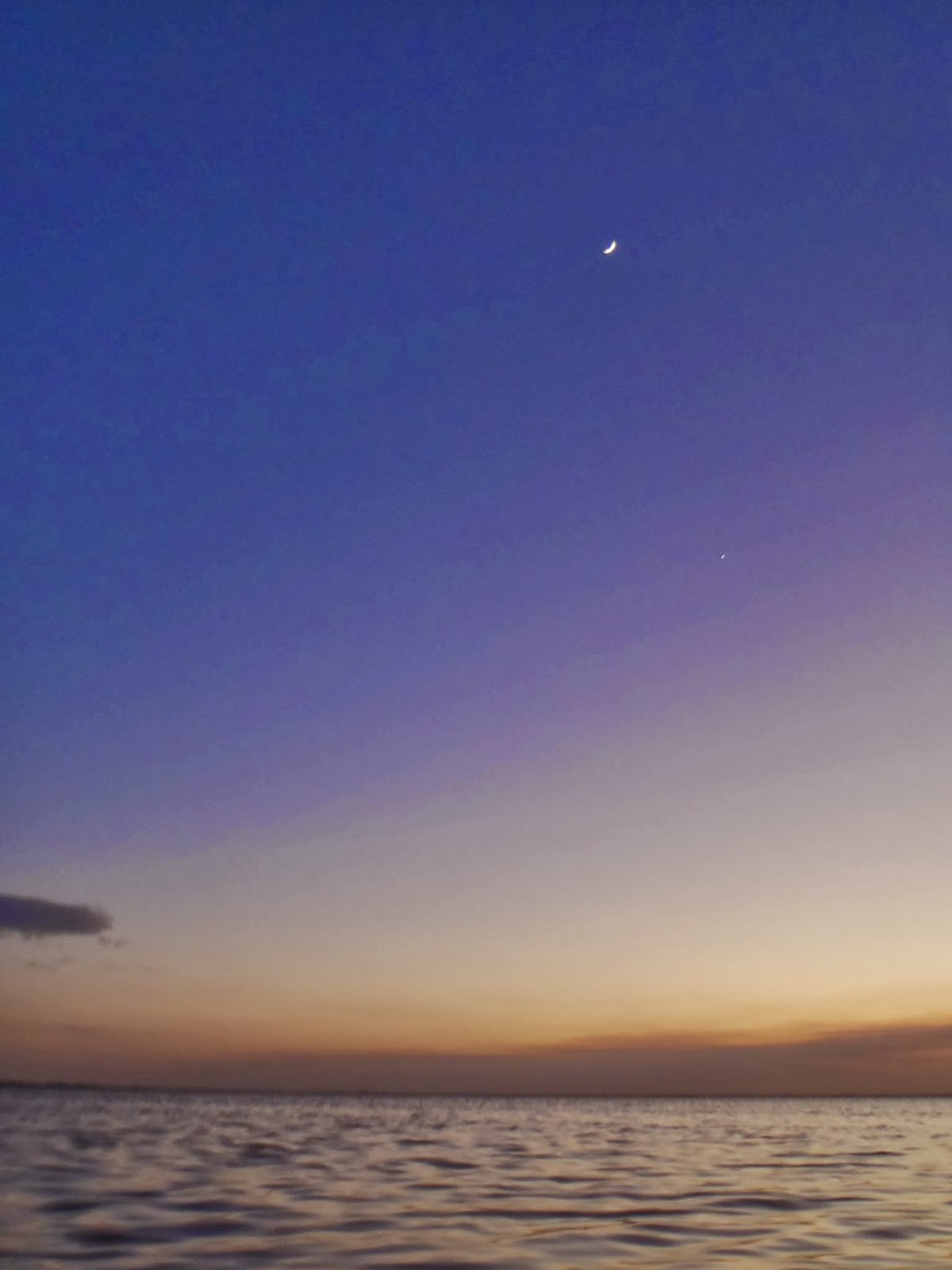
Just a sliver of a moon. My wife noted that it seems the wrong way 'round down here.
Soon to be heading in search of glowing jellyfish.
Waiting for it to become dark enough for the bioluminescent comb jellyfish to appear. There are no photos of that because, like my previous attempts to photograph bioluminescence with a point & shoot camera, it didn't work.
Highlights of the paddle were definitely seeing the wildlife while on the water. We saw an alligator up close, heard wild pigs in the bush, saw the nostrils and upwelling from the tails of a couple of manatees, saw the dorsal fins and backs of a couple of dolphins, saw osprey, vultures, herons, and kingfishers, saw many jumping fish, heard the strange sounds of red drum fish in the dark, and held glowing comb jellyfish with their undulating lights.
Partial GPS track of our paddle. In total, we paddled only about 7 km during 3 hours or so on the water. The straight line is where I had the GPS off for a while.
Close up look at a part of the paddle that Tim referred to as "the Maze", where we saw the alligator and the manatees. From the water level, things seem quite natural. From the satellite views it seems clear that the area is heavily modified by humans.
A broader look at the area we paddled (purple squiggles at center). Cape Canaveral is at the lower right, Titusville is to the left, Cocoa Beach would be farther south.
Our guide, Tim Raley happens to have an online persona as "Primitive Tim". Check out his blog at http://primitivetim.blogspot.ca/ and his youtube channel at http://www.youtube.com/user/PrimitiveTim. Here's a video he posted a few days after our tour; I wonder if it's the same 'gator? (I'm sure it isn't.)
Driving to the river on Sunday morning to head out for a winter paddle, I was listening to the radio. The Sunday Edition was airing an article about a singing coach, Tom Schilling. Schilling was interviewed and among the things he said was a line that stuck with me:
"We teach what we have to learn ourselves."
I like that. It reflects some of the reasons I teach people to paddle. One of the benefits of becoming a paddling instructor is that it has made me a better paddler, to better understand the skills so that I can better teach them to my students. It also reflects that we are always learning, that a good teacher is always working to improve both their teaching and the skillset they are sharing.
Mr. Schilling also said a few other things that struck a chord and are relevant to a paddling instructor. He teaches people to use their voice as an instrument. I rely heavily on my voice to teach and even though few would describe it as musical, it is one of my teaching instruments. He described how a good singer must learn to get big sounds without forcing it, without power. He related the analogy of the tiny locust that creates a sound heard for miles. I know this is one of my challenges - after a day of instructing in the outdoors, especially with some wind, my voice is tired. I've spoken to my good friend Mike about this in the past. Mike is a school teacher and involved in theatre. He described some techniques for learning to project my voice, but I have yet to get the hang of them (more specifically, to put in the required practice).
So, perhaps to become a better kayak instructor, I really need to sign up for some singing lessons!
A friend mentioned paddling the Cochrane River in northern Saskatchewan today. Not knowing much about the river, I Googled it. I found some interesting things, but among them was this resource that I thought was pretty neat, the book Canoeing North Into the Unknown: A Record of River Travel, 1874 to 1974, by Bruce W. Hodgins, Gwyneth Hoyle. It seems to be a listing of various folks that have paddled many northern Canadian rivers.
It looks like the book is out of print and rather expensive ($140 used on Amazon.ca), but it's going on my book list for sure (never know what you might come across at a garage sale or used bookstore).
Our part of the world is frozen pretty solid right now but I still got out for some paddling in December. Never mind that it was in Florida where their winter temperatures (water and air) were nearly as warm as it ever gets here in the summer. On Thursday I paddled an afternoon in the ocean to have fun and hone my skills, and on Friday our family went on a tour on protected waters to see some Floridian wildlife. I'll cover that tour in a separate post.
First, since I don't often get a lot of coastal paddling in and I wanted to work on those skills, I hired Michael Shugg to do an afternoon session of coastal kayak skills with me. Mostly, I wanted to learn to play and tour in surf conditions. Michael is an American Canoe Association instructor from Orlando and he recently started the company Adventure Spirit Kayaking. We started out at a Port Canaveral boat launch, not far from a number of cruise ships, then headed out around the point to the beach at Cape Canaveral/Cocoa Beach.
Palm trees and cruise ships at the launch - things you just don't see much of in Saskatchewan.
Once out of the port area and clear of the boat traffic, I tried a couple of rolls on both sides to get rid of any rust that might have built up from a couple of months off of the water. We then took advantage of the bit of swell (1.5 feet?) to catch some waves coming in to the beach, working first on coming in slower than the waves and in control, as you would do with a load while touring. That was easy enough so then we spent most of the afternoon working on catching and surfing the waves. On my very first attempt to surf some waves in toward shore I was broached (the following wave pushed my stern sideways until I was parallel to the wave) and I quickly capsized since I hadn't yet learned to lean into the wave. I rolled back up quite nicely so it was great to see my roll working in the real world conditions.
A pretty calm day out there but there was some swell, I swear it!
It was also remarkable how warm the water was. I was pretty comfortable in just a rash guard and shorts over neoprene shorts. Just guessing, I'd say the water was pretty close to 20°C and the air was close to 25°C. Like I said, warm summer conditions (if we're lucky).
Michael.
That's probably one of the waves I should have been surfing, rather than trying to catch on the camera.
I did have difficulties with a couple of aspects. First, it was hard for this prairie guy to time the waves - I often seemed to pick a little one that didn't surf me well, then I'd get halfway to the beach and end up getting the larger wave(s) that were following the one I picked. These waves would be steeper by the time I was trying to catch them and I wouldn't get a good ride before being broached. I also had some trouble picking the right spot as they always seemed to be bigger, 'just over there.'
On shore for a snack. Bryan's little tip: don't toss a water bottle and open bag of crackers into the day hatch loose together when you expect to be rolling over and over in the surf. The water bottle will smash your crackers to bits and make quite the mess in the day hatch, especially when that hatch cover comes off later during rescue practice.
Myself after handing the camera to Michael for a while. It looks too calm for a helmet, but it did come in handy a couple of times when I approached the beach helmet-side-down.
A successful surf into the beach.
Another thing that I did wrong at first but which quickly got better (until the end again when I seemed to be losing it), was that I leaned the wrong direction while broaching and the wave would dump me upside down pretty quickly. I learned (thanks to Michael) that I needed to keep the hull toward the beach while bracing on the wave. When I did that well, the wave couldn't capsize me.
Ready to head back out again for another try.
Low bracing as the wave spills away underneath me.
Finally, I had troubles controlling my angle on the wave. Most of my paddling is forward (or backward) and I can easily control the direction with correction strokes. Surfing a wave, you use a stern rudder which although I know how to do it in general, it's not totally intuitive or natural for me yet. I have to think about it and by the time I think about it, it's too late and I'm starting to broach on the wave.
I surfed backwards (on purpose) once or twice and in some respects that was easier for me since I could see what waves were coming. Heading out through the waves was interesting - that's the first time I've been smacked in the chest by a (short) wall of water. It was easy though to reach past the wave, plant my paddle, and power through. That's relatively small stuff though - I can see how that would be a challenge in some bigger surf.
On shore, ready to head out for another run.
By the time we were done I had salt water in every orifice in my body and had been more or less pummelled by the breaking waves (usually right at shore where it was very shallow). I did get Michael to take a video of me - unfortunately he captured my surf that ended in my one and only wet exit (I later practiced some rescues, but those were intentional wet exits). Looking at this video (below), it looks like I was bailing and setting up for a capsize and roll long before the surf actually dumped me. By this time it was getting toward the end of the afternoon and the surf had rolled me rather a lot of times. I guess I was maybe starting to anticipate what seemed inevitable?
We finished up the afternoon with some rescue practice - more rolling on each side, then re-enter & roll, then cowboy re-entry (which went very well other than popping my day hatch cover loose and getting my crackers soggy), then bow rescue, then a t-rescue. After that, we paddled back to the launch, a trip I'm certain was much longer than it was on the way out. Paddling back through the port entrance, we passed two cruise ships on their way out to the ocean, including a Disney ship which was just as loud as the theme parks my family had just visited in the first 2/3 of our trip to Florida. At the same time that one of the cruise ships was passing us, we paddled past a moored gambling cruise ship (much smaller than the other 2 ships, but a large ship nonetheless). We were no more than 60' from each of these massive building-sized boats in our tiny watercraft.
All in all it was a great afternoon on the water. I was glad to have made a new paddling acquaintance in Michael, I learned a lot, and I have lots to practice on Lake Diefenbaker or Lac La Ronge when the water warms up a bit.
Tons of fun.
If you find yourself in Florida and itching to get out kayaking and learn some skills, I highly recommend Michael Shugg and Adventure Spirit Kayaking.