Badger's Blog: How to Maintain Oiled Gunnels and Wood Paddles
Having a look at the Badger Blog has reminded that I need to get my seats & thwarts oiled before the season starts!
Tales of boatbuilding, family, paddling, music, camping, football, snowshoeing, kids, cycling, and whatever else suits my fancy.
Wednesday, April 21, 2010
Sunday, April 18, 2010
Pulled Pork
I'm smoking a pork butt for supper on Sunday. I am going to update this post as I go.
The subject: 9lb Pork butt, bone in. $3.59/pound. Purchased at Prairie Meats. I'm not sure if this is a good price, or a bad one. (After reading on the 'net, it seems that this is not a good price. Our American neighbours can get it at well under a dollar per pound while folks out in Ontario are paying about $2.50 - I'll keeping my eye out for sale prices for future pork endeavours, perhaps talking directly to my local hog producer.)
The recipe: http://www.susanminor.org/forums/showthread.php?p=99#post99
For advice on the timing, I've been referring to various posts at http://forum.bradleysmoker.com/ which suggest that pork butt can take anywhere from 12 to 24 hours before it's ready to pull. The variance is due to the size and shape of the meat, the smoking/cooking temperature, the fat & connective tissue content of the particular pieces of meat, and more. Affecting the cooking temperature are factors like outside temperature, wind, sunshine, etc. The experts at the aforementioned forum also suggest that it is MUCH better to have your butt done early and to let it "rest" longer than to be waiting on the meat to reach an internal temperature of 190°F.
So, here's how things are playing out:
Saturday, 8:00 pm - Applied pork rub following recipe at http://www.susanminor.org/forums/showthread.php?p=99#post99. The recipe calls for a 1/4 cup of freshly cracked pepper. That's a lot of pepper to grind by hand so I connected the cordless drill to the pepper grinder in order to do it in a more efficient (and manly) manner.
Sunday, 12:00 am - Took the pork out of the fridge, applied more rub. Set up smoker in the back yard and loaded smoker with several rocks to help hold & recover heat when the door opens. Filled water pan with boiling water to help the cabinet (and the rocks) heat up. The ambient temperature is about 6°C so the heat setting on the smoker cabinet is full bore in order to combat the cold of night. Also have the smoke generator turned on to pre-heat it, and to help warm the cabinet.
1:00 am - Put pork into the smoker and loaded 4 hours, 40 minutes worth of wood "bisquettes". Used 2/3 apple, 1/3 hickory.
1:40 am - Checked the smoker temperature before heading off to bed - the cabinet thermometer is already reading at about 185°F! That's a quicker rise than I expected considering the big slab of meat is still relatively cool and moist, and it's not very warm outside. Rather than head off to bed as planned, I'm staying up to tweak the temperature in order to have the cabinet running at the desired 200 - 210°F. The heat control on my Bradley smoker is a simple slider, with not temperature setting. Thus, it requires some monitoring and adjusting in order to hit a target.
My desire to get a PID temperature controller has just jumped up a couple of notches! In the meantime, I make an adjustment, wait a fair bit of time for the cabinet to react and stabilise, then check and make another adjustment. This is repeated until the target is reached. However, changing outside temperatures or wind affect this, and the changing food inside the cabinet also affect this so it's a moving target.
In the meantime, I have had the time to write all of the above....
2:15 am - The cabinet is at close to the same temperature as 35 minutes earlier, perhaps just a few degrees higher. So, it seems like I can safely head off to bed now for a few hours.
7:15 am - I had the alarm set for 6 am, but apparently I didn't turn it on. Got up to check on things, and all seemed OK. Temperature is stilll low at about 190°F so it's not like it's goign to burn up too soon. Back to bed...
9:00 am - Checking on things again.... Temp still at about 190 or 195. Refilled water bowl with boiling water and inserted probe of digital thermometer.
Overnight low was about 1°C for several hours. Current temperature is 11°C, it's calm and the sun is shining.
4:50 pm - Guests will be here in less than an hour, and the butt isn't done yet! The internal temperature is 169°F and I need it to be up to at least 175 (higher is better) before I pull it. I think I'm going to have to put it in the oven to finish it off. I don't know, do I leave it alone for another hour or so (the cabinet is at about 230°F), or do I take preemptive action?
While I was at it, this afternoon I did two "Bacon Explosions" similar to what I did last fall for the Grey Cup. I used another hours worth of apple wood smoke on that. One is stuffed with bacon, fried onion & mushrooms, and the other has less of the same, but a can of green chilis added. That stuffing is wrapped in pork sausage meat, wrapped in a woven bacon wrap. I'll follow up with photos.
6:00 pm - Bacon Explosion for an appetizer!
6:15 pm - I left the pork in the smoker and it reached 178°F, then I took it out, wrapped it in foil, then a towel, and put it into a small cooler (the FTC method - no, I'm not making this up!). There it "rested" about 20 minutes before I unwrapped it all and used a couple of forks to pull the pork. Oh, man was it ever moist and tender - literally falling apart! Of course I sampled as I went, and oh man, was it good.
6:40 pm - Supper's on!
17 hours of cooking created one of the best meats I have ever prepared. Was it worth the sleep deprivation? Hell yes. My sandwiches at work have been pretty darned good at work all week too. In fact, I think this stuff might be getter better with age. My only comment would be that perhaps bacon-wrapped bacon is a bit much for an appetizer that is followed immediately by a massive feed of more smoked pork. Today (Wednesday) I vacuum bagged the remaining leftovers and tossed it in the freezer to keep for a later date. The second bacon explosion was also vacuum bagged and I'll bring that with me tomorrow night and re-heat it in Jay's oven during his birthday celebration.
Next time.... put it in earlier, set the smoker to high (depending on the weather), and go to bed while the smoker and the pork take care of themselves.
The subject: 9lb Pork butt, bone in. $3.59/pound. Purchased at Prairie Meats. I'm not sure if this is a good price, or a bad one. (After reading on the 'net, it seems that this is not a good price. Our American neighbours can get it at well under a dollar per pound while folks out in Ontario are paying about $2.50 - I'll keeping my eye out for sale prices for future pork endeavours, perhaps talking directly to my local hog producer.)
The recipe: http://www.susanminor.org/forums/showthread.php?p=99#post99
For advice on the timing, I've been referring to various posts at http://forum.bradleysmoker.com/ which suggest that pork butt can take anywhere from 12 to 24 hours before it's ready to pull. The variance is due to the size and shape of the meat, the smoking/cooking temperature, the fat & connective tissue content of the particular pieces of meat, and more. Affecting the cooking temperature are factors like outside temperature, wind, sunshine, etc. The experts at the aforementioned forum also suggest that it is MUCH better to have your butt done early and to let it "rest" longer than to be waiting on the meat to reach an internal temperature of 190°F.
So, here's how things are playing out:
Saturday, 8:00 pm - Applied pork rub following recipe at http://www.susanminor.org/forums/showthread.php?p=99#post99. The recipe calls for a 1/4 cup of freshly cracked pepper. That's a lot of pepper to grind by hand so I connected the cordless drill to the pepper grinder in order to do it in a more efficient (and manly) manner.
Sunday, 12:00 am - Took the pork out of the fridge, applied more rub. Set up smoker in the back yard and loaded smoker with several rocks to help hold & recover heat when the door opens. Filled water pan with boiling water to help the cabinet (and the rocks) heat up. The ambient temperature is about 6°C so the heat setting on the smoker cabinet is full bore in order to combat the cold of night. Also have the smoke generator turned on to pre-heat it, and to help warm the cabinet.
1:00 am - Put pork into the smoker and loaded 4 hours, 40 minutes worth of wood "bisquettes". Used 2/3 apple, 1/3 hickory.
1:40 am - Checked the smoker temperature before heading off to bed - the cabinet thermometer is already reading at about 185°F! That's a quicker rise than I expected considering the big slab of meat is still relatively cool and moist, and it's not very warm outside. Rather than head off to bed as planned, I'm staying up to tweak the temperature in order to have the cabinet running at the desired 200 - 210°F. The heat control on my Bradley smoker is a simple slider, with not temperature setting. Thus, it requires some monitoring and adjusting in order to hit a target.
My desire to get a PID temperature controller has just jumped up a couple of notches! In the meantime, I make an adjustment, wait a fair bit of time for the cabinet to react and stabilise, then check and make another adjustment. This is repeated until the target is reached. However, changing outside temperatures or wind affect this, and the changing food inside the cabinet also affect this so it's a moving target.
In the meantime, I have had the time to write all of the above....
2:15 am - The cabinet is at close to the same temperature as 35 minutes earlier, perhaps just a few degrees higher. So, it seems like I can safely head off to bed now for a few hours.
7:15 am - I had the alarm set for 6 am, but apparently I didn't turn it on. Got up to check on things, and all seemed OK. Temperature is stilll low at about 190°F so it's not like it's goign to burn up too soon. Back to bed...
9:00 am - Checking on things again.... Temp still at about 190 or 195. Refilled water bowl with boiling water and inserted probe of digital thermometer.
Overnight low was about 1°C for several hours. Current temperature is 11°C, it's calm and the sun is shining.
4:50 pm - Guests will be here in less than an hour, and the butt isn't done yet! The internal temperature is 169°F and I need it to be up to at least 175 (higher is better) before I pull it. I think I'm going to have to put it in the oven to finish it off. I don't know, do I leave it alone for another hour or so (the cabinet is at about 230°F), or do I take preemptive action?
While I was at it, this afternoon I did two "Bacon Explosions" similar to what I did last fall for the Grey Cup. I used another hours worth of apple wood smoke on that. One is stuffed with bacon, fried onion & mushrooms, and the other has less of the same, but a can of green chilis added. That stuffing is wrapped in pork sausage meat, wrapped in a woven bacon wrap. I'll follow up with photos.
6:00 pm - Bacon Explosion for an appetizer!
![]() |
| Jay digs into the Bacon Explosion - Fried mushrooms, onions & bacon wrapped in pork sausage meat, wrapped in woven bacon. |
6:40 pm - Supper's on!
![]() |
| Pulled pork ready to eat. |
![]() |
| Not my best picture, but damn, that was a good sandwich! |
![]() |
| Not Jay's best picture either, but I think that's one happy pork-eater. |
Next time.... put it in earlier, set the smoker to high (depending on the weather), and go to bed while the smoker and the pork take care of themselves.
Wednesday, April 14, 2010
Summer Plans
Our family is making plans for summer paddling. It looks like we will find ourselves in the Broken Group Islands, Pacific Rim National Park, for a few days in July.
Here is a map of the area.
Here is a video showing off some aspects of the Broken Group. Also note the "related videos" on YouTube. It looks like I have more viewing ahead of me (or I'll just wait to see it for myself).
And here is a link to a neat little video that shows the scenery, and fog, very well.
Here is a map of the area.
Here is a video showing off some aspects of the Broken Group. Also note the "related videos" on YouTube. It looks like I have more viewing ahead of me (or I'll just wait to see it for myself).
And here is a link to a neat little video that shows the scenery, and fog, very well.
Monday, April 05, 2010
Burning Hell Paddles to the Dawson City Music Festival
This is pretty cool, I heard recently on CBC Radio 3 that The Burning Hell will be playing at the Dawson City Music Fetival (#1 on the list of music festivals I want to visit some day!) this summer. What's cool about that is how they are getting there. They will first drive across the country to Whitehorse, an epic journey in itself. However, not satisfied to do things the usual way, they will then be hopping into canoes and PADDLING the 730 kilometers to Dawson City down the Yukon River. What a helluva way to do it!
In related news, The Burning Hell write on their blog about why Bruno, SK, has the "coolest indie music scene in Canada." You can read all about it at http://www.wearetheburninghell.com/node/106. Here's an excerpt:
And in other news, I just realised the The Burning Hell member Mathias Kom is half of a duo with Kim Barlow known as Spring Breakup. Kim & Mathias played a house concert in my basement last year.
In related news, The Burning Hell write on their blog about why Bruno, SK, has the "coolest indie music scene in Canada." You can read all about it at http://www.wearetheburninghell.com/node/106. Here's an excerpt:
Sorry Montreal: your glory days are over, and no amount of fires or arcades or little moustaches, tight pants and 80s sunglasses can save you. Bruno, Saskatchewan is the best indie music scene in Canada.Who knew?
And in other news, I just realised the The Burning Hell member Mathias Kom is half of a duo with Kim Barlow known as Spring Breakup. Kim & Mathias played a house concert in my basement last year.
Saturday, April 03, 2010
It's Springtime & Time To Ride
OK, so some of us haven't quit riding all year, but the number of excuses not to ride is rapidly dwindling with the warm springtime weather. My kids and I have been out quite a bit lately and my younger daughter (4) really loves being the stoker behind me on her Adams Trail-a-Bike. It's so much easier to pull than the trailer and she pedals too. My older daughter (7) loves riding her own bike but enjoys stints on the Trail-a-Bike too. When she's back there, I can really feel her contributing which is something I don't detect with the younger one. Our range so far with the older daughter riding her own bike is a 6.6 km return trip to the grocery store. I look forward to seeing that grow over the summer.
I came across this video over at bicyclesmile.com and thought I'd share it with you here. Gives lots of warm happy "springtime with the kids" feelings.
Monday, March 08, 2010
Sunday, March 07, 2010
Lessons Learned: Nistowiak Falls Trip
After our trip to Nistowiak Falls in northern Saskatchewan, the group shared via e-mail some of the things they learned on this trip. It's a way to think about and document these ideas so that we don't have to re-learn them again next time. Here is my contribution to the discussion:
That, more or less, is my own personal list. Below are some of the highlights from things others in the group shared, including some of the more humorous points. Keep in mind that our group was composed of experience levels ranging from novice to more experienced and the reflections offered below are going to be affected by that somewhat.
- 12 km is a long way with a heavy load through hills, but it can be done. On the flats (lake travel) it would be easier, and without skidoo tracks would be much harder. (Note that I do think the way we broke it up into 12km & 8km was the best possible arrangement given our goal of the falls).
- I think I could manage even solo with the current canvas tent (17 pounds, sleeps 3-4, co-owned by Rob & I) and stove (25 lbs with stove pipe, 22 gauge, built hours before the trip by Rod), though I would not attempt to go very far. A smaller stove and tent would of course be better for solo or tandem travel.
- Camera batteries don't work well when really cold. Always keep a spare battery in a pocket so it can be used.
- Black spruce boughs work well as a bed/floor, but takes a lot of time to collect with our spindly northern trees.
- Black spruce firewood produces a lot of sparks. These embers come out of my current chimney (4 lengths of 5" x 18" black stove pipe, plus two elbows) and can fall onto nearby stuff, including the tent. One ember burned a nickel-sized hole in the tent.
- I will add a length or two of 4" 26 gauge galvanized pipe, and a reducer to the stove pipe - the extra stovepipe will nest inside the existing pipe inside the stove.
I may also add a spark arrestor to the stove pipe.I've since learned that spark arrestors can be a problem, even dangerous.- A heat shield or piece of canvas to protect sleeping bags, pads & other gear inside the tent while the stove door is open may also be useful.
- The hole burned by the ember was still burning when I noticed it, but it was progressing very slowly (or not at all I - I didn't leave it long enough to measure it's rate of progress). It also smelled bad. Both good signs.
- For more about the stove, see the post at http://northstarexped.blogspot.com/2010/03/making-wood-stove.html
- My sleeping system worked: thin MEC overbag, -12C MEC down bag, and a Serratus vapour barrier liner. I think this is the first time I've ever used the VBL even though I've brought it on numerous trips. The wool long undies absorbed what minimal sweat there was and I woke up barely damp. I was able to wear the same long underwear that morning.
- It is very important to have kindling and everything ready to light the stove fire long before bed time. Matches, along with a striking surface must be at hand too. I quickly lost all dexterity trying to light the fire with bare fingers and non-functioning lighters.
- Lighters don't work when it's really cold.
- The fire-starters I made using paper towel & vaseline worked very well. (See here for a pictorial "how to" - http://wintertrekking.com/
index.php?topic=333.0). - Even at -30°C I don't need a heavy winter jacket.
- My layering system worked - on the coldest morning I was wearing most of what I had brought, but not yet everything.
- That included a fleece sweater, wool jacket, a polypro midweight layer, and wool long undies on top, covered by a nylon shell jacket.
- On my legs I wore three layers - wool long undies, heavy fleece pants, and wool army surplus pants.
- Before heading out on the trail, some of these layers were removed.
- Some day I want to replace my nylon shell with something like this.
- Body glide works.
- You can chop a hole in ice, even when it's nearly 3 feet thick, using just a medium sized axe. But...
- For getting water through thick ice, an ice chisel would be helpful.
- I must look at garage sales more carefully for old axes (and ice chisels). Bob's old Hudson Bay axe was very nice.
- A vent at the top of the tent might be helpful to vent warm, moist air. That would likely speed drying.
- There is a huge temperature gradient in the tent when the stove is going - the closer to the wall, the cooler it is; and the higher, the hotter.
- I need to think more about food.
- Gummies are really hard when frozen.
- Cubed cheese worked but sliced cheese froze together.
- Chocolate covered coffee beans are still damn fine in GORP.
- Some people get tired of eating frozen food.
- Soft, oily cookies would be good snack/lunch items.
- I should cut up meats into cubes the way I did the cheese.
- The milk crate at the front of the sled works well as an easy access "glove box", but without a top things can get lost.
- I need to learn how to tie better knots! (One or two of the knots on the lashing lines of the toboggan came loose. Others had similar troubles too.)
- Long and low is a good way to haul gear.
- There is skill involved in driving a 10 foot toboggan.
- The downhills can be lined with bow and stern lines much as you line a canoe in rapids.
- Steeper downhills can be ridden, steering done with the ropes and using the snowshoes like skis on each side.
- Allowing the sled to overrun its ropes when heading downhill allows the ropes to act like a brake.
- Ropes and strap allow quite a few options for towing.
- Arms wrapped backwards in the ropes act like shock absorbers and help take up the slack rather than having the ropes yank me suddenly off my feet when the sled stops.
- That toboggan can haul a lot of stuff! After the trip I weighed most of it, and came up with some estimates for the rest:
- Sled - 20 lbs
- Stove with pipe - 25 lbs
- Gear duffle (part) - 30 lbs
- Food box (part) - 20 lbs
- Food - 5 lbs
- Beer - 5 lbs
- Clothes, sleeping bags, and sleeping pads - 20 lbs
- 2 full water bottles and a thermos - 6 lbs
- Boots - 4 lbs
- Other miscellaneous gear - 5 lbs
- That's a whopping total in the neighbourhood of 140 lbs!
- My steel thermos works well. Filled with coffee at a gas station in La Ronge, the coffee was still (luke)warm a full 24 hours later even though the temperatures were -30°C.
- My homemade blue foam water bottle insulator works well. Yes, the water does start to freeze inside but it lasts a few hours on the trail in cold temperatures (time enough for me to finish the uninsulated water bottle).
- Don't stick your hands in front of the end of the stove pipe to warm them up when wearing polypropylene gloves.
- Leave other people's "juice" bottles alone, don't try to do them any favours.
- Nistowiak falls is worth it!
That, more or less, is my own personal list. Below are some of the highlights from things others in the group shared, including some of the more humorous points. Keep in mind that our group was composed of experience levels ranging from novice to more experienced and the reflections offered below are going to be affected by that somewhat.
- "I need to rethink my lunch menu. I knew that smoked salmon would freeze but I thought that I would at least be able to break pieces off. I was wrong, a knife was needed to cut pieces."
- "I need to keep a knife on me at all times. For now I think that I'm going to keep a small folding knife on a lanyard around my neck."
- "Bob's (Norlund) axe is a delight to use, I need to get one similar."
- "I'm going to look into getting a vapour barrier for inside my sleeping bag for those cold nights"
- "I can certainly appreciate the benefits of a hot tent."
- "I learned to change into dry clothes asap."
- MEC "hut booties are the best investment ever."
- "Cheese in cubes would work, I didn't bring any cheese, but cheezies are like cheese."
- "Wine in a (tetra)pak" not bottles.
- "Baileys."
- "Instant coffee."
- "Beef Jerky and cheezies are the only things that didn't freeze...muffins were crumbly/edible and yummy"
- "Bryan's whisky seemed to be 'less solid' than my wine..."
- "Freeze suppers to size of pots."
- "I need 2 pair of gloves[inners] for when one gets wet."
- "Nalgene with blue foam really works...hot/warm drinks when it's really cold is a 'gawd send.'"
- "Tie my bloody stuff in properly."
- "I learned the temp was...minus stupid f...ing cold."
- "Chopping wood keeps you warm."
- "A nalgene of boiling water in your sleeping bag is a must at night."
- "It is hard to find good food for lunchtime which doesn't freeze."
- "I LOVE Bryan's hot tent."
- "Pulling 80 lbs is too much for day 3."
- "My boots do not keep my feet warm at -30 especially when just standing around camp."
- "The falls were amazing and worth all the discomfort."
- "Black fleece pants are easily confused with other people's black fleece pants of the same make and model!"
Nistowiak Falls by Snowshoe
Over the recent Family Day Weekend I went with a group of 5 others to visit a popular scenic destination in northern Saskatchewan, Nistowiak Falls. This is the third time I've been to the falls, the difference this time being that it was winter and we travelled by snowshoe rather than the more typical summertime canoe trip.
The trip was organised by Mark Lafontaine, who has written his own account of the trip on his blog at http://wildpaddler.blogspot.com. We planned for a 4 day trip, with a total distance to cover of 40 km, starting and finishing in the community of Stanley Mission. Our goal for the first day was the shores of Iskwatikan Lake and a distance of about 12 km. That would leave us an 8 km trek to the falls on the second day, for a 16 km round trip with a light load. The third day was planned as a day of local exploration, relaxation, rest and recovery. On our fourth day we would head back home again via the same route.The forecast for the trip was for nothing but mild weather with lows in the -15 range and highs that had me concerned about getting wet from melting snow (not a good thing when winter camping). Well, that's what was expected anyway...
An embedded map showing the community of Stanley Mission, approximately 500 km North of Saskatoon:
View Larger Map
Stanley Mission is a Cree community of about 1,400 people on the shores of Mountain Lake, part of the Churchill River. From Stanley, the Churchill flows eastward through Stanley Rapids into Drope Lake and Nistowiak Lake beyond. Stanley Mission is a common start point for canoeing and fishing adventures, a common trip being to paddle downstream to Nistowiak Lake in order to view Nistowiak Falls. The falls themselves are not part of the Churchill River, but rather the Rapid River. However, they are located just a couple hundred metres from where the Rapid River joins the Churchill River at Nistowiak Lake.
Our group stayed in a motel in La Ronge on Friday night so as to be ready to start our journey early on Saturday morning. Our first sign that the forecasters had got it wrong was the groan with which our vehicles reluctantly started outside the motel in the pre-dawn of Saturday morning. After a few delays and with our vehicles safely parked at the RCMP depot, we started out form the easternmost point of Stanley, a peninsula that juts out into the Churchill River. The temperature when we started out was cold, about -25C, and despite the sunshine a fog hung in the air from the nearby open water of the river. The fog made for a really great visual effect, forming an undulating layer about 20 to 30 feet above the ground and only about 10 to 20 feet thick. My camera batteries were too cold for the camera to work (having spent the night in the car) so some of these initial photos are courtesy of Zoe & Mark.
This trip was my first one using my new UHMW (ultra high molecular weight polyethylene) plastic toboggan. Made from a 1/4" thick, 10' by 16" piece of plastic, there is a little about 9' of loadable space behind the front curl. Unlike the pulks of the others which are being towed by ropes through metal or plastic conduit as poles and connected to a harness, I used rope. I connected the rope via small carabiners to a beefy fanny pack that doubles as harness, or to a 36"' length of 2" webbing (a tump). The webbing strap could be positioned in any of a variety of ways, including across my chest or over one shoulder and down to my side and is a more traditional way to pull this high tech old-fashioned toboggan. When using the fanny pack, I had my hands free to use ski poles to help myself push up the hills. However, when going up one steep section, the buckle of the pack came apart and the 140 pound sled slid backwards down the hill, nearly taking out Bob in the process.
As seen in the previous photo, my load had a milk crate at the bow, two duffel bags amidships, then the stove and a grub box (wannigan) at the stern. The milk crate served as a sort of "glove box" for the sled - a place I could toss loose items and keep spare mitts, a shell, snacks, coffee and water handy. However, being open topped, it's easy to lose items and I think some sort of easy to access lid may be better. The duffels are narrow enough not to overhang the sides, one containing my clothing and sleeping bags, the other containing miscellaneous camping gear. The stove contains the stove pipe and legs inside and the bungees holding the stove down are also holding the extra pieces of elbow. Finally, the grub box contains most of the food for two of us and also had enough room to contain my extra boots. My small shovel is strapped on top and an extra sweater is tucked under the bungee cords. The load is secured with bungee cords across each section, and a rope zigzags across the duffels to help ensure their sides don't overhang the sled. One major advantage of this system is the load height. My load was mostly under 12" tall, and whatever extended above 12" was very light (that grub box on the back was only 3/4 full). That means it's stable and does not easily tip when going over an obstacle. Also, the undulating nature of the sled allowed it to climb over obstacles one section at a time while the remainder of the sled remained fairly flat on the ground. This is in contrast to some of the other sleds which were shorter and piled much higher.
Our path followed a skidoo trail away from the Churchill River overland for 10 km to Iskwatikan Lake, crossing a handful of small lakes (the largest being Bow Lake), sloughs and beaver ponds along the way. The path was usually fairly narrow, about one snowmobile wide, and was well travelled. Occasionally we were overtaken or met a snowmobile on the trail which required that we make haste and get off the trail in a hurry. My toboggan was sometimes difficult to get off of the trail quickly and required a certain amount of clear space in the bush into which I could head into. However, off trail, the sled handled and negotiated surprisingly well through the underbrush and between the trees.
The hills on our route were generally short and steep, with the trail undulating over ridges. However, there were a few brutal long, though not overly steep, sections to climb. It was going up those hills that I really noticed the weight on my sled (later weighed and approximated to be 140 pounds, about 60 pounds higher than anyone else!). This being my first time using the new toboggan, it took me some time to really learn to drive it. There are some skills involved, especially for managing the downhills. When towing with my arms wrapped behind me in the ropes, I found that they work as a sort of shock absorber allowing me to take up some of the slack when the sled was catching up to me, and to absorb the shock when the sled slowed. Also, when the toboggan ran downhill, it would run over it's ropes which would then act as a brake and usually keep the sled from catching up to me. For other downhills I found that by holding the tow ropes and the stern rope at the same time, I could walk the sled downhill, much like lining a canoe down a rapid. I was also able to walk the sled downhill from behind while holding onto the towing ropes (which is why I had made the ropes over 10 feet long so that they would reach all the way from the bow to behind the sled).
After travelling along the shore of Iskwatikan Lake for about two kilometers we found a place along shore that looked promising for a camp. The spot we eventually settled on was back a bit from the shore, tucked into the black spruce in a spot that would have been horribly buggy and damp in the summer. However, in the winter it serves just fine.
Our evening around the fire was a tad cool as the temperatures never did get very warm that day (in contrast with the forecast) and the evening temperatures were around -25C. It was off to bed relatively early since it would be another early morning the next day. Mike & I retired to the hot tent and got the stove going again (we had it running earlier in the evening for a while after camp was set up) while we prepared for bed.
My sleeping system included a thermarest pad with a shorter foam pad underneath (and a layer of spruce boughs), a -12C MEC bag, a MEC overbag, and a vapour barrier liner. The latter was being used for the first time. I've brought it along a number of times but never felt it was cold enough to warrant it's use. I've also been somewhat put off by the thought of sleeping inside a non-breathable plastic bag which surely must feel damp and clammy. I wore Stanfield superwash wool long undies, thin merino wool liner socks, and a toque to bed and not only was it not clammy and damp, but I was comfortably warm all night. Except my face; that did get cold and I rectified it sometime in the night or early morning by pulling on a fleece hood & face covering.
We awoke to -30C temperatures so I quickly (no, make that 'reluctantly') set about getting the fire ready. Unfortunately, we didn't have a lot of firewood and kindling ready to go, so I found myself scrambling for wood and snapping branches into shorter pieces of kindling, and gathering my fire lighting supplies. I then learned that my lighter would not work at -30, it was too cold. Switching to matches, I could not find anywhere to strike my "strike anywhere" matches. The stove was too new to have any rust or rough spots, and we were sleeping on a bed of moss and snow covered in pine boughs, not a rock anywhere. Of course, striking one match against the other always works, but by now I had lost all dexterity in my cold hands and I could not manage to get better than sparks before wrecking the heads. With thoughts of the Jack London "To Build a Fire" story in mind, I switched back to the lighter which I had been sitting on in the meantime in order to warm it. Thankfully, this time it worked and I was able to get the stove lit, but not before becoming quite chilled. I returned to the sleeping bag while I waited for the tent to warm with the fire and while listening to Mark getting the main campfire going outside.
Our plan was for a quick breakfast before hitting the trail, but camp duties take longer in the cold and some got quite cold in the early morning hours. Also, some had a cold night with sleeping systems that were insufficient at minus 30. Eventually we did get underway and those that were chilled could begin warming themselves through activity.
The falls were 8 km away from our camp and we followed the skidoo trails on Nistowiak Lake. At one point there are a couple of islands that one must go between so we exercised a fair degree of caution in that area. Although we were on a lake, it is part of the Rapid River there is potential for current around points and between islands. We spread our group out so that no more than one person could run into trouble at once. We also carried ropes or throw bags to assist in a rescue form the water if need be. Thirdly, we stuck to the snowmobile trails where others had passed safely before us. The snowmobiles pack the snow and decrease it's insulative value allowing the ice to freeze more thickly.
Once in the vicinity of the falls, we followed the trail inland. This trail starts well above where the river exits the lake, unlike the usual canoe portage. We toured down to the first rapid that marks where Iskwatikan Lake spills into the Rapid River, then continued on to the top of the main waterfall. There, we found ourselves in awe. The waterfall plummets 10m and in doing so throws up a large amount of spray. In the winter cold that spray freezes to everything it touches and as a result the scenery of the waterfall is an ice-covered wonder. The sheer quantities of ice that entombed the trees was incredible. The colours of the ice, and the rainbows in the bright winter sun were visually impressive. At the moment that each person reached the top of the falls they knew the cold and long trek was worth it. A written description and even photos won't really do it justice, you are just going to have to take a trip there for yourself.
We spent about an hour at the waterfall, taking in the scenery, basking in the sunshine, and eating a frozen lunch. We did not explore down to the bottom of the falls, or Fissher Rapids below, and being concerned about getting back to camp with a wide margin of remaining daylight, we got back on the trail across Iskwatikan Lake. The temperatures for the return trip had warmed up to about -15C and we had a slight tail wind, very nice travelling conditions. We were heading into the declining sun and I was glad to have my goggles with me. In fact, several folks developed a good sun tan on the trip and my wife commented later that I had a lot more freckles. Sunblock would have been warranted given the amount of light that was being reflected off of the white world around us.
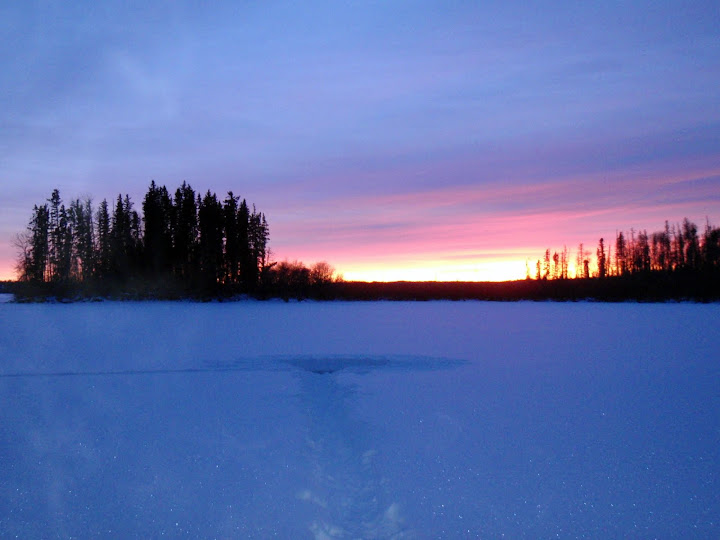
Back at camp on our second evening we endeavoured to put up a lot more wood in order to be better prepared for both evening fires and for the coming morning. Zoe sawed and sawed and sawed. The rest of us collected, dragged and split, spelling Zoe off the saw for short stints. Mike & I also collected a bunch more spruce boughs in order to improve our bedding in the tent. We enjoyed a beautiful evening in camp with a gorgeous sunset and I think the temperatures actually continued to rise a bit. Mark noted that he thought the weather had turned (for the better) and he would later be proven correct.
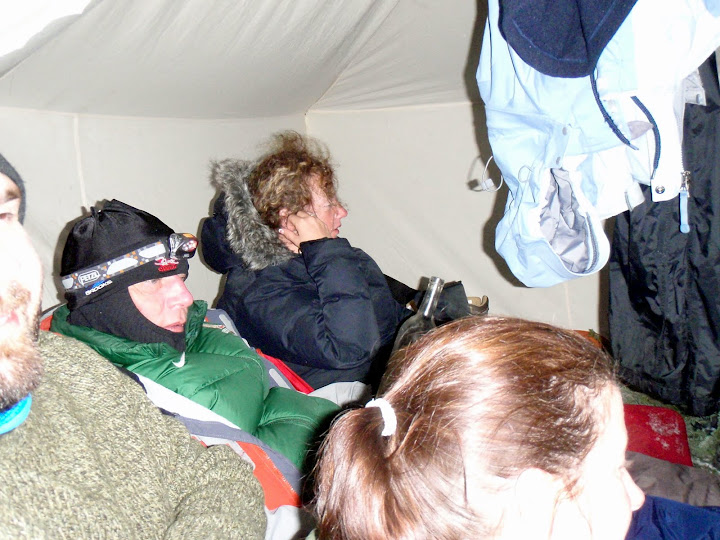
After supper by the fire, we retired to an evening in the hot tent with the stove burning, something we should perhaps have done the previous evening when the temperatures were much lower. The tent easily accommodates 6 relaxing folks.
Because of the cold earlier in the trip we had decided to pack up and head out on our third day, originally planned as a day to relax or explore near camp. That was decision was made in the cold of the second day, and I think some were relieved. There was concern it seems over how some would keep warm during the relative inactivity of our rest day. So, it was another early morning the next day in order to break camp and get started on the long haul out. Our second morning broke much warmer than the previous one and life in camp was pretty comfortable. After packing everything up and loading the sleds, we struck out on our return to Stanley Mission.
The return trip was nearly as hard as the trek in, but the weather was sunny, calm and pleasant. The temperatures were certainly climbing. We were in a bit of a hurry to ensure we made it back at a reasonable hour in order to pick up our vehicles from the police station. Once we got out in the open near the town of Stanley Mission we became aware of a stiff breeze blowing.
After retrieving our vehicles from the police station and loading everything in, we began the long drive home. The drive was uneventful, except that Mike was feeling the full effect of flu-like symptoms he began to feel on the trail. Thankfully, there were no unexpected stops on the side of the road to account for this. I did make one extra stop in an effort to help some folks change their tire on their half-ton. It was one with the spare stored underneath the vehicle and released by inserting a crank and turning to lower the cable. Unfortunately, something was stuck or broken because nothing I could do helped. It was about then that the lady mentioned none of the previous 6 guys that stopped had any luck either. Thankfully, a tow truck from La Ronge arrived about the time I was leaving.
Back at home, I was generally tired as hell for the next few days, literally wiped out. My muscles were sore, but not overly so, and time in Mike's sauna may have helped alleviated some of the aches in that regard.
All in all, it was a great trip. I learned that some of my untested stuff worked very well at minus thirty, and I learned that I could withstand an arduous but adventurous trip. I still think it would have been better with the extra day in there to rest up a bit and enjoy life around camp before heading out, but I know better now what my limits might be. I have a long list of things learned from this trip, something the group all shared with each other by e-mail after the trip. I'll re-format and paste the list in as a post of it's own.
The trip was organised by Mark Lafontaine, who has written his own account of the trip on his blog at http://wildpaddler.blogspot.com. We planned for a 4 day trip, with a total distance to cover of 40 km, starting and finishing in the community of Stanley Mission. Our goal for the first day was the shores of Iskwatikan Lake and a distance of about 12 km. That would leave us an 8 km trek to the falls on the second day, for a 16 km round trip with a light load. The third day was planned as a day of local exploration, relaxation, rest and recovery. On our fourth day we would head back home again via the same route.The forecast for the trip was for nothing but mild weather with lows in the -15 range and highs that had me concerned about getting wet from melting snow (not a good thing when winter camping). Well, that's what was expected anyway...
An embedded map showing the community of Stanley Mission, approximately 500 km North of Saskatoon:
View Larger Map
Stanley Mission is a Cree community of about 1,400 people on the shores of Mountain Lake, part of the Churchill River. From Stanley, the Churchill flows eastward through Stanley Rapids into Drope Lake and Nistowiak Lake beyond. Stanley Mission is a common start point for canoeing and fishing adventures, a common trip being to paddle downstream to Nistowiak Lake in order to view Nistowiak Falls. The falls themselves are not part of the Churchill River, but rather the Rapid River. However, they are located just a couple hundred metres from where the Rapid River joins the Churchill River at Nistowiak Lake.
(Click image for a full-sized version)
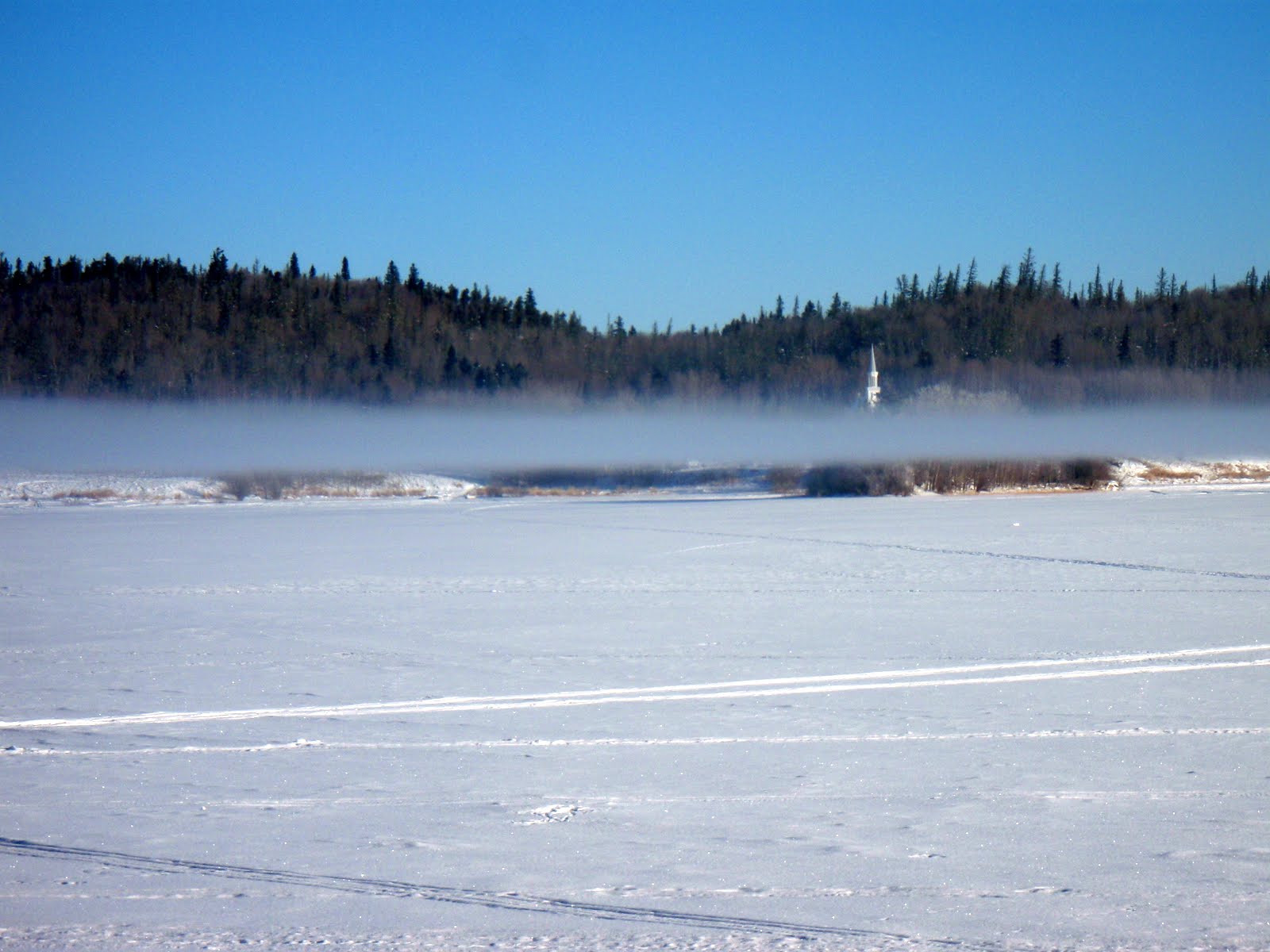
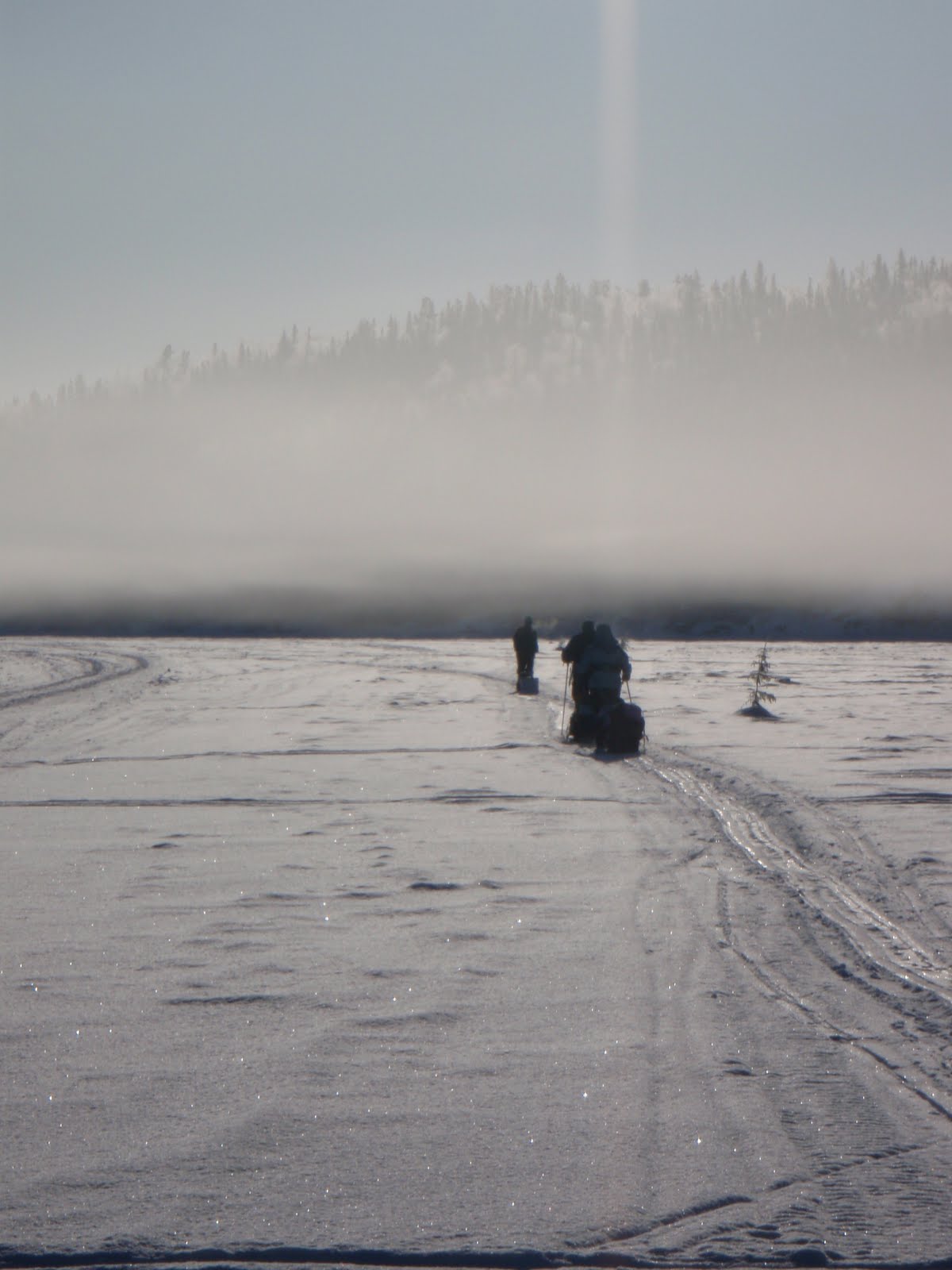
Our group stayed in a motel in La Ronge on Friday night so as to be ready to start our journey early on Saturday morning. Our first sign that the forecasters had got it wrong was the groan with which our vehicles reluctantly started outside the motel in the pre-dawn of Saturday morning. After a few delays and with our vehicles safely parked at the RCMP depot, we started out form the easternmost point of Stanley, a peninsula that juts out into the Churchill River. The temperature when we started out was cold, about -25C, and despite the sunshine a fog hung in the air from the nearby open water of the river. The fog made for a really great visual effect, forming an undulating layer about 20 to 30 feet above the ground and only about 10 to 20 feet thick. My camera batteries were too cold for the camera to work (having spent the night in the car) so some of these initial photos are courtesy of Zoe & Mark.
From the road, looking toward the peninsula where we unloaded the vehicles and started off.
Mark, Zoe, Bryan (me!) Laurie, Bob & Mike ready to go. Mark & Zoe's photo.
Fog in front of the church at Stanley Mission. Mark & Zoe's photo.
Me, setting out with my loaded toboggan. Mark & Zoe's photo.
Following the skidoo trail away from Stanley and under ribbons of fog. Mark & Zoe's photo.
This trip was my first one using my new UHMW (ultra high molecular weight polyethylene) plastic toboggan. Made from a 1/4" thick, 10' by 16" piece of plastic, there is a little about 9' of loadable space behind the front curl. Unlike the pulks of the others which are being towed by ropes through metal or plastic conduit as poles and connected to a harness, I used rope. I connected the rope via small carabiners to a beefy fanny pack that doubles as harness, or to a 36"' length of 2" webbing (a tump). The webbing strap could be positioned in any of a variety of ways, including across my chest or over one shoulder and down to my side and is a more traditional way to pull this high tech old-fashioned toboggan. When using the fanny pack, I had my hands free to use ski poles to help myself push up the hills. However, when going up one steep section, the buckle of the pack came apart and the 140 pound sled slid backwards down the hill, nearly taking out Bob in the process.
The first leg of our route out of (and into) Stanley Mission as recorded by GPS, click for a larger image. The purple line is actually from our way out, with the white lines being what was recorded on the way in. I was using regular and weak AA batteries initially and the GPS did not start working consistently until those were swapped for fresh lithium batteries.
Our path followed a skidoo trail away from the Churchill River overland for 10 km to Iskwatikan Lake, crossing a handful of small lakes (the largest being Bow Lake), sloughs and beaver ponds along the way. The path was usually fairly narrow, about one snowmobile wide, and was well travelled. Occasionally we were overtaken or met a snowmobile on the trail which required that we make haste and get off the trail in a hurry. My toboggan was sometimes difficult to get off of the trail quickly and required a certain amount of clear space in the bush into which I could head into. However, off trail, the sled handled and negotiated surprisingly well through the underbrush and between the trees.
The hills on our route were generally short and steep, with the trail undulating over ridges. However, there were a few brutal long, though not overly steep, sections to climb. It was going up those hills that I really noticed the weight on my sled (later weighed and approximated to be 140 pounds, about 60 pounds higher than anyone else!). This being my first time using the new toboggan, it took me some time to really learn to drive it. There are some skills involved, especially for managing the downhills. When towing with my arms wrapped behind me in the ropes, I found that they work as a sort of shock absorber allowing me to take up some of the slack when the sled was catching up to me, and to absorb the shock when the sled slowed. Also, when the toboggan ran downhill, it would run over it's ropes which would then act as a brake and usually keep the sled from catching up to me. For other downhills I found that by holding the tow ropes and the stern rope at the same time, I could walk the sled downhill, much like lining a canoe down a rapid. I was also able to walk the sled downhill from behind while holding onto the towing ropes (which is why I had made the ropes over 10 feet long so that they would reach all the way from the bow to behind the sled).
Walking the sled downhill ahead of me.
Another look at the toboggan. There is a short rope on the front allowing something to grab other than the long towing ropes when desired. There are also a pair of eye bolts attached to u-bolts that go through the tow bar. The eye bolts are attachment points for rigid poles similar to that used on my pulks, as system I wanted to try out but I forgot the poles at home. The eye bolts are fitted into a short piece of garden hose to keep them from dangling down.
A short video of me learning what happens on the short steep hills when the sled abruptly stops, but I don't.
Second leg of our route into Iskwatikan Lake and our campsite (click for a larger version). There were was a high ridge to cross to reach the lake.
Elevation profile of the route as generated by MapSource v. 6.15.
Elevation profile recorded by the GPS. This is after some of the most obviously out of whack points have been cleaned up, but a couple remain.
Bryan, Mark, Bob, Zoe, Mike & Laurie enjoying the sunshine after arriving on Iskwatikan Lake. This photo was taken for us by a Stanley Mission family that also stopped for a rest en route by skidoo to their cabin, another 58km farther. Mark & Zoe's photo.
After travelling along the shore of Iskwatikan Lake for about two kilometers we found a place along shore that looked promising for a camp. The spot we eventually settled on was back a bit from the shore, tucked into the black spruce in a spot that would have been horribly buggy and damp in the summer. However, in the winter it serves just fine.
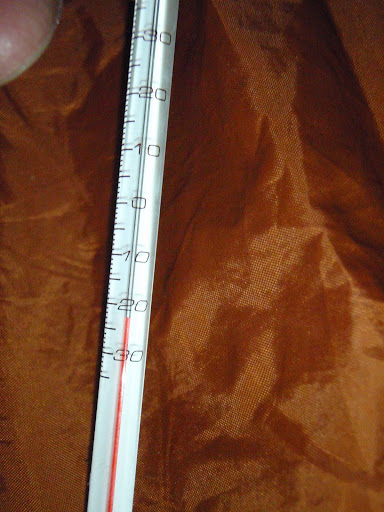
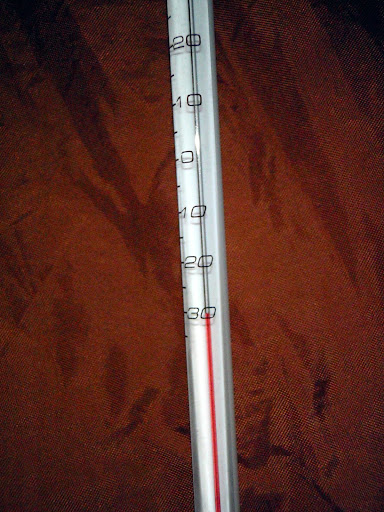
Our evening around the fire was a tad cool as the temperatures never did get very warm that day (in contrast with the forecast) and the evening temperatures were around -25C. It was off to bed relatively early since it would be another early morning the next day. Mike & I retired to the hot tent and got the stove going again (we had it running earlier in the evening for a while after camp was set up) while we prepared for bed.
Mark's thermometer at some point in the first evening. Mark & Zoe's photo.
My sleeping system included a thermarest pad with a shorter foam pad underneath (and a layer of spruce boughs), a -12C MEC bag, a MEC overbag, and a vapour barrier liner. The latter was being used for the first time. I've brought it along a number of times but never felt it was cold enough to warrant it's use. I've also been somewhat put off by the thought of sleeping inside a non-breathable plastic bag which surely must feel damp and clammy. I wore Stanfield superwash wool long undies, thin merino wool liner socks, and a toque to bed and not only was it not clammy and damp, but I was comfortably warm all night. Except my face; that did get cold and I rectified it sometime in the night or early morning by pulling on a fleece hood & face covering.
We awoke to -30C temperatures so I quickly (no, make that 'reluctantly') set about getting the fire ready. Unfortunately, we didn't have a lot of firewood and kindling ready to go, so I found myself scrambling for wood and snapping branches into shorter pieces of kindling, and gathering my fire lighting supplies. I then learned that my lighter would not work at -30, it was too cold. Switching to matches, I could not find anywhere to strike my "strike anywhere" matches. The stove was too new to have any rust or rough spots, and we were sleeping on a bed of moss and snow covered in pine boughs, not a rock anywhere. Of course, striking one match against the other always works, but by now I had lost all dexterity in my cold hands and I could not manage to get better than sparks before wrecking the heads. With thoughts of the Jack London "To Build a Fire" story in mind, I switched back to the lighter which I had been sitting on in the meantime in order to warm it. Thankfully, this time it worked and I was able to get the stove lit, but not before becoming quite chilled. I returned to the sleeping bag while I waited for the tent to warm with the fire and while listening to Mark getting the main campfire going outside.
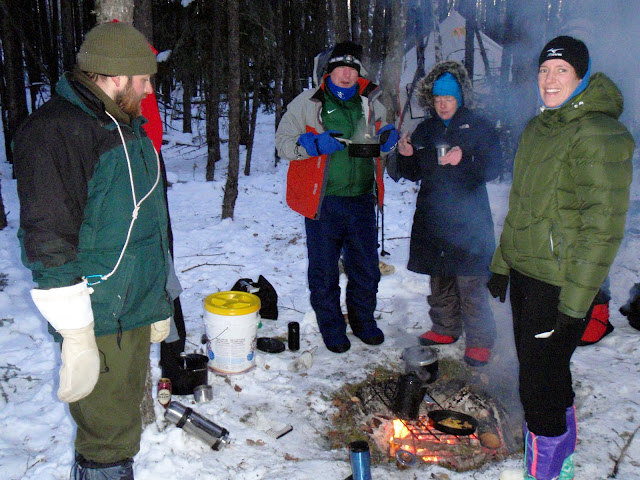
Breakfast by the campfire. Mark & Zoe's photos.
Our plan was for a quick breakfast before hitting the trail, but camp duties take longer in the cold and some got quite cold in the early morning hours. Also, some had a cold night with sleeping systems that were insufficient at minus 30. Eventually we did get underway and those that were chilled could begin warming themselves through activity.
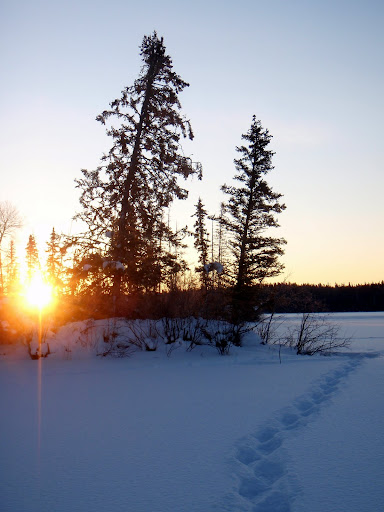
Sunrise near camp. Mark & Zoe's photo.
The falls were 8 km away from our camp and we followed the skidoo trails on Nistowiak Lake. At one point there are a couple of islands that one must go between so we exercised a fair degree of caution in that area. Although we were on a lake, it is part of the Rapid River there is potential for current around points and between islands. We spread our group out so that no more than one person could run into trouble at once. We also carried ropes or throw bags to assist in a rescue form the water if need be. Thirdly, we stuck to the snowmobile trails where others had passed safely before us. The snowmobiles pack the snow and decrease it's insulative value allowing the ice to freeze more thickly.
Once in the vicinity of the falls, we followed the trail inland. This trail starts well above where the river exits the lake, unlike the usual canoe portage. We toured down to the first rapid that marks where Iskwatikan Lake spills into the Rapid River, then continued on to the top of the main waterfall. There, we found ourselves in awe. The waterfall plummets 10m and in doing so throws up a large amount of spray. In the winter cold that spray freezes to everything it touches and as a result the scenery of the waterfall is an ice-covered wonder. The sheer quantities of ice that entombed the trees was incredible. The colours of the ice, and the rainbows in the bright winter sun were visually impressive. At the moment that each person reached the top of the falls they knew the cold and long trek was worth it. A written description and even photos won't really do it justice, you are just going to have to take a trip there for yourself.
Mike looking out toward Iskwatikan Lake from the top of the first rapid.
The first rapid exiting Nistowiak Lake, about 300 m above Nistowiak Falls.
The pool below the first drop and above Nistowiak Falls.
Zoe enjoying the scenery of the first rapid.
Mark heading back out on the trail toward Nistowiak Falls.
En route to the falls.
Looking back toward the first rapid while en route to the falls.
There was some confusion over which way to go (which led to our side trip to the top rapids). But, being skilled and experienced woodsmen, we were able to read the signs of nature to find our way.
Mark, Zoe, Mike & Laurie take in the scenery at the falls.
Some of the huge masses of ice formed by the spray being thrown up onto the trees and rocks.
The first drop of the falls.
Rainbows in the sunshine.
Mike absorbing the spectacle.
Mark heads down toward another vantage point.
Lunch above the falls.
We spent about an hour at the waterfall, taking in the scenery, basking in the sunshine, and eating a frozen lunch. We did not explore down to the bottom of the falls, or Fissher Rapids below, and being concerned about getting back to camp with a wide margin of remaining daylight, we got back on the trail across Iskwatikan Lake. The temperatures for the return trip had warmed up to about -15C and we had a slight tail wind, very nice travelling conditions. We were heading into the declining sun and I was glad to have my goggles with me. In fact, several folks developed a good sun tan on the trip and my wife commented later that I had a lot more freckles. Sunblock would have been warranted given the amount of light that was being reflected off of the white world around us.
Brilliant sunshine and sundogs.
Bob and Mark lead the way.
Some of the Iskwatikan Lake geography.
Mike and Laurie. Laurie must be finally warm - no toque or mitts!
Heading toward a narrows between the islands.
The group spreading out for safer ice travel.
Mark & Zoe and a valentine's message.
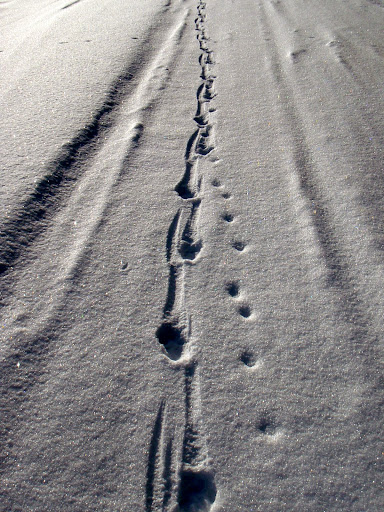
Wolf tracks near camp. Mark & Zoe's photo.
Mark & Zoe's photo.
Back at camp on our second evening we endeavoured to put up a lot more wood in order to be better prepared for both evening fires and for the coming morning. Zoe sawed and sawed and sawed. The rest of us collected, dragged and split, spelling Zoe off the saw for short stints. Mike & I also collected a bunch more spruce boughs in order to improve our bedding in the tent. We enjoyed a beautiful evening in camp with a gorgeous sunset and I think the temperatures actually continued to rise a bit. Mark noted that he thought the weather had turned (for the better) and he would later be proven correct.
Mark & Zoe's tent.
Setting sunlight on the trees.
Sunset over the water hole. Mark & Zoe's photo.
Bob by the campfire with a gorgeous sky beyond.
Laurie dressed to stay warm while relaxing by the fire.
Mark & Bob tend to their suppers while discussing the best methods for thawing frozen wine and why glass bottles of wine are not ideal.
Valentine's evening at camp.
After supper by the fire, we retired to an evening in the hot tent with the stove burning, something we should perhaps have done the previous evening when the temperatures were much lower. The tent easily accommodates 6 relaxing folks.
Because of the cold earlier in the trip we had decided to pack up and head out on our third day, originally planned as a day to relax or explore near camp. That was decision was made in the cold of the second day, and I think some were relieved. There was concern it seems over how some would keep warm during the relative inactivity of our rest day. So, it was another early morning the next day in order to break camp and get started on the long haul out. Our second morning broke much warmer than the previous one and life in camp was pretty comfortable. After packing everything up and loading the sleds, we struck out on our return to Stanley Mission.
Making a few adjustments before leaving Nistowiak Lake and entering the overland skidoo trail to Stanley.
The return trip was nearly as hard as the trek in, but the weather was sunny, calm and pleasant. The temperatures were certainly climbing. We were in a bit of a hurry to ensure we made it back at a reasonable hour in order to pick up our vehicles from the police station. Once we got out in the open near the town of Stanley Mission we became aware of a stiff breeze blowing.
Some of the exposed shield capped in snow.
A look at the trail.
A lunch break of tea and gorp in a sunny spot en route.
Emerging from the trail into a bay near Stanley Mission.
Our trail passed a bit less than 1km south of the Holy Trinity Anglican Church.
Open water of the Churchill River near Stanley Mission. Amachęwęsp imawin Cliff is in the background.
After retrieving our vehicles from the police station and loading everything in, we began the long drive home. The drive was uneventful, except that Mike was feeling the full effect of flu-like symptoms he began to feel on the trail. Thankfully, there were no unexpected stops on the side of the road to account for this. I did make one extra stop in an effort to help some folks change their tire on their half-ton. It was one with the spare stored underneath the vehicle and released by inserting a crank and turning to lower the cable. Unfortunately, something was stuck or broken because nothing I could do helped. It was about then that the lady mentioned none of the previous 6 guys that stopped had any luck either. Thankfully, a tow truck from La Ronge arrived about the time I was leaving.
Back at home, I was generally tired as hell for the next few days, literally wiped out. My muscles were sore, but not overly so, and time in Mike's sauna may have helped alleviated some of the aches in that regard.
All in all, it was a great trip. I learned that some of my untested stuff worked very well at minus thirty, and I learned that I could withstand an arduous but adventurous trip. I still think it would have been better with the extra day in there to rest up a bit and enjoy life around camp before heading out, but I know better now what my limits might be. I have a long list of things learned from this trip, something the group all shared with each other by e-mail after the trip. I'll re-format and paste the list in as a post of it's own.
Our complete route in and out from Nistowiak Lake. Click on the image to view full size.
For a list of Lessons Learned, see the post at http://pawistik.blogspot.com/2010/03/lessons-learned-nistowiak-falls-trip.html.
Subscribe to:
Posts (Atom)