Showing posts with label tools. Show all posts
Showing posts with label tools. Show all posts
Sunday, January 10, 2010
Keep My Fingers Away From That Blade
Many of us that work with table saws and wood have heard of the SawStop over recent years. It's a table saw that can sense when it's no longer cutting just wood, but is cutting flesh, and stops it self rather dramatically to protect your hands. Most of us have seen the videos that show what happens when a wiener is used as a substitute for a human finger to demo the SawStop. However, this was a new take on the demo video for me. Watch the video, it's worth a few minutes to see.


Monday, July 28, 2008
Stapleless Boat Building
Today Glen posted on the Kayak Building Bulletin Board a link to photos from the recent joint WCHA reunion and Bear Mountain Rendezvous 2008. Going through a few of those photos, something caught my eye (aside from many beautiful wooden boats). It was a series of photos that depicted a novel method of securing strips for stapleless building. Building with wood strips requires that the strips be held tightly to adjacent strips while the glue dries, and to the station mold for the duration of the stripping. 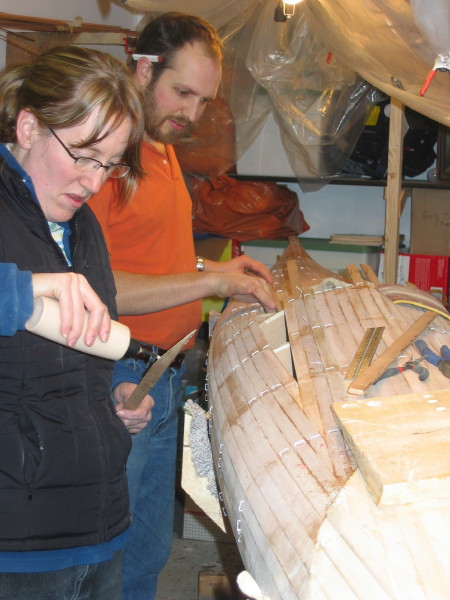 Typically, staples are used to achieve this. Staples are fast and effective, but they do leave behind a row of little holes at each station. Many builders use clamps, jigs, tape and bungee cord (or all of the above) to hold the strips in place while building.
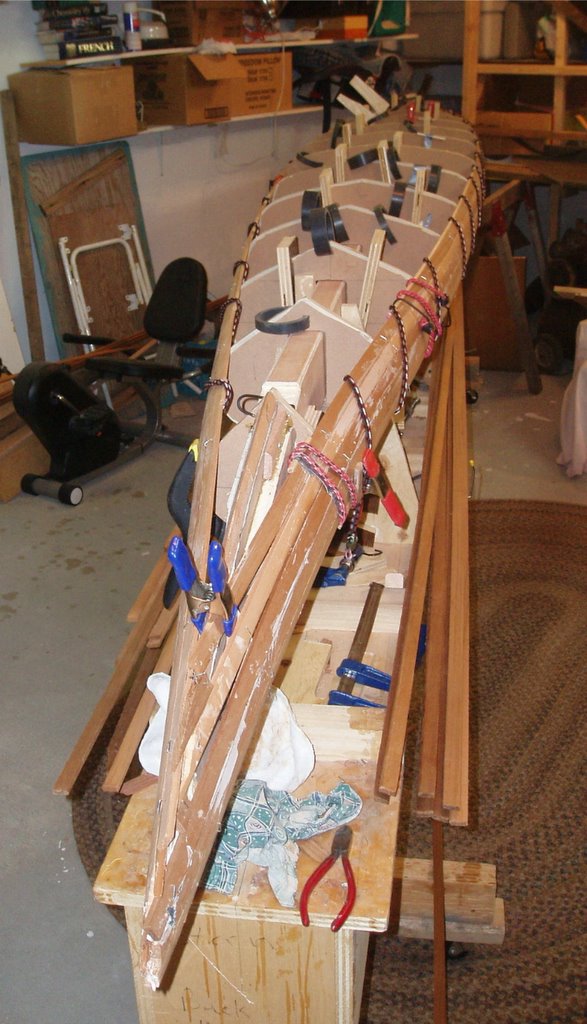 I tried this initially while building the Guillemot, but I decided to revert to staples in the name of speed and efficiency. The method shown in Glen's photos from the BM Rendezvous uses a wire device attached to bungee to hold the strips down against the previous strips, the bungee is tightened using a chain that can be hooked to the right length to the strongback. Meanwhile, a strap which goes around each form keeps the strips tight to the forms. This latter component seems to solve one of the perpetual problems of some stapleless methods which would allow the joined strips to move away from the forms. In areas such as at the bow of the Guillemot kayak which have a concave curve, wedges would probably be needed to maintain the pressure to hold the strips tightly to the forms.
The straps and jigs are being assembled and sold as a kit by Ron Frenette of Canadian Canoes. The kits are pricey ($375) but seem like a pretty slick system for building a fine piece of woodcraft.

 Typically, staples are used to achieve this. Staples are fast and effective, but they do leave behind a row of little holes at each station. Many builders use clamps, jigs, tape and bungee cord (or all of the above) to hold the strips in place while building.
 I tried this initially while building the Guillemot, but I decided to revert to staples in the name of speed and efficiency. The method shown in Glen's photos from the BM Rendezvous uses a wire device attached to bungee to hold the strips down against the previous strips, the bungee is tightened using a chain that can be hooked to the right length to the strongback. Meanwhile, a strap which goes around each form keeps the strips tight to the forms. This latter component seems to solve one of the perpetual problems of some stapleless methods which would allow the joined strips to move away from the forms. In areas such as at the bow of the Guillemot kayak which have a concave curve, wedges would probably be needed to maintain the pressure to hold the strips tightly to the forms.
The straps and jigs are being assembled and sold as a kit by Ron Frenette of Canadian Canoes. The kits are pricey ($375) but seem like a pretty slick system for building a fine piece of woodcraft.
Tuesday, April 01, 2008
Cool New Tool!
I love it whenever Lee Valley introduces a new tool, and once a year they really seem to break the mold for conventional tools. Today's offering is the Veritas® Full-Round Spokeshave.
I can already think of a myriad of uses for such a tool in my shop, not the least of which would be for shaping paddle shafts such as the one I will need to build for my daughter so she can use her Sea Flea.
Be sure to check the LV description for this item, as well as the supplementary information page.
 | |
Be sure to check the LV description for this item, as well as the supplementary information page.
Monday, March 31, 2008
Gunwale Work
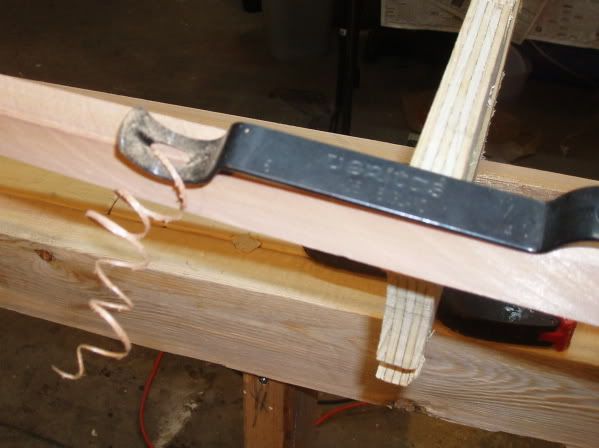
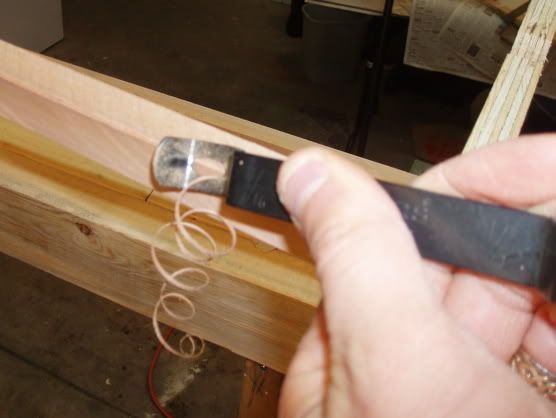
I have given the top outside corner of the gunwales a 1/4" radius rounded profile using a Veritas cornering tool. This handy little tool quickly rounds off the corners of the cedar gunwales.

 Later, I will use the tool to take the sharp corners off of the keel and chines.
 Later, I will use the tool to take the sharp corners off of the keel and chines.
Tuesday, April 03, 2007
Scraping By
Much is said in the boat building forums in favour of the lowly paint scraper for fiberglass work and I finally figured out why. When well sharpened the paint scraper works very well for removing high spots, bumps, drips, runs, edges and excess glass/epoxy. My success with the scraper was initially limited, but since then it has been very helpful. The trick is getting the tool sharp and keeping it that way. In order to sharpen the scraper I clamp the handle into a bench vise. Then with a flat file (nothing fancy here, just a hand-me-down from the toolbox) held horizontal I move the file across the scraping edge a number of times. Every once in a while I remove the burr from the back-side of the cutting edge by passing the file across the back edge, holding the file flat against the blade back. Thirty seconds of attention will restore the edge allowing effective scraping with little effort. Since this is not high carbon steel, the edge dulls quickly so requires resharpening after a few minutes of work on fully cured epoxy (green epoxy, being softer is less harsh on the blade). My one caution while sharpening with the file is to ensure that all of your digits pass well clear of the blade. I once allowed my thumb to be sliced open during sharpening of the scraper.
The replaceable blades are double edged. I have reshaped one side of the blade currently in the tool so that it is curved. I used the flat file for reshaping but this could probably be more quickly done with a grinding wheel. A curved blade allows the tool to be useful in concave areas, a rather handy feature for the interior of the boat. Another tip is to take the sharp corners off of the straight scraper blade. The sharp corners, if left on, tend to catch and gouge or slice into the epoxy. To remove the corners, simply round them off with the flat file.
The replaceable blades are double edged. I have reshaped one side of the blade currently in the tool so that it is curved. I used the flat file for reshaping but this could probably be more quickly done with a grinding wheel. A curved blade allows the tool to be useful in concave areas, a rather handy feature for the interior of the boat. Another tip is to take the sharp corners off of the straight scraper blade. The sharp corners, if left on, tend to catch and gouge or slice into the epoxy. To remove the corners, simply round them off with the flat file.
Saturday, April 01, 2006
Veritas� Pouchless Tool Belt - Lee Valley Tools
Since my block blane, chisel, scraper or saw are invariable on the other side of the strongback and boat, I thought the new Veritas "Pouchless Tool Belt" from Lee Valley Tools was a great idea. I'm gonna order one as soon as I can get my credit card remagnetized.
Subscribe to:
Posts (Atom)