Sunday, March 07, 2010

Nistowiak Falls by Snowshoe

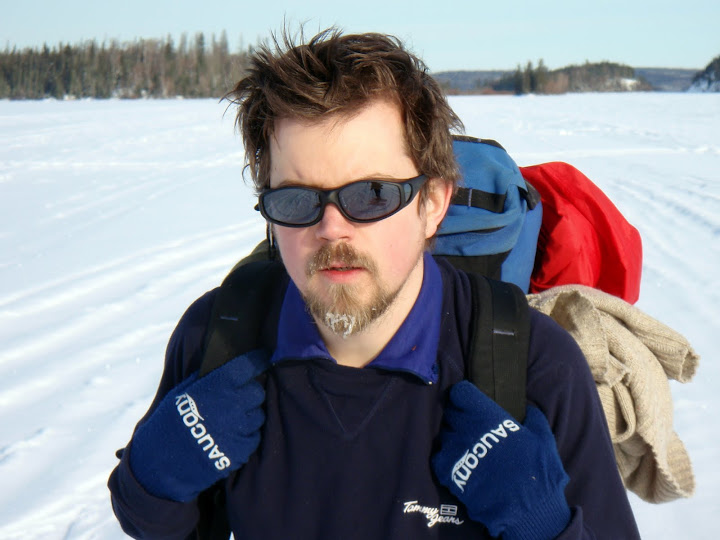
Over the recent Family Day Weekend I went with a group of 5 others to visit a popular scenic destination in northern Saskatchewan, Nistowiak Falls. This is the third time I've been to the falls, the difference this time being that it was winter and we travelled by snowshoe rather than the more typical summertime canoe trip.

The trip was organised by Mark Lafontaine, who has written his own account of the trip on his blog at http://wildpaddler.blogspot.com. We planned for a 4 day trip, with a total distance to cover of 40 km, starting and finishing in the community of Stanley Mission. Our goal for the first day was the shores of Iskwatikan Lake and a distance of about 12 km. That would leave us an 8 km trek to the falls on the second day, for a 16 km round trip with a light load. The third day was planned as a day of local exploration, relaxation, rest and recovery. On our fourth day we would head back home again via the same route.The forecast for the trip was for nothing but mild weather with lows in the -15 range and highs that had me concerned about getting wet from melting snow (not a good thing when winter camping). Well, that's what was expected anyway...

An embedded map showing the community of Stanley Mission, approximately 500 km North of Saskatoon:

View Larger Map


Stanley Mission is a Cree community of about 1,400 people on the shores of Mountain Lake, part of the Churchill River. From Stanley, the Churchill flows eastward through Stanley Rapids into Drope Lake and Nistowiak Lake beyond. Stanley Mission is a common start point for canoeing and fishing adventures, a common trip being to paddle downstream to Nistowiak Lake in order to view Nistowiak Falls. The falls themselves are not part of the Churchill River, but rather the Rapid River. However, they are located just a couple hundred metres from where the Rapid River joins the Churchill River at Nistowiak Lake.

 (Click image for a full-sized version)

Our group stayed in a motel in La Ronge on Friday night so as to be ready to start our journey early on Saturday morning. Our first sign that the forecasters had got it wrong was the groan with which our vehicles reluctantly started outside the motel in the pre-dawn of Saturday morning. After a few delays and with our vehicles safely parked at the RCMP depot, we started out form the easternmost point of Stanley, a peninsula that juts out into the Churchill River. The temperature when we started out was cold, about -25C, and despite the sunshine a fog hung in the air from the nearby open water of the river. The fog made for a really great visual effect, forming an undulating layer about 20 to 30 feet above the ground and only about 10 to 20 feet thick. My camera batteries were too cold for the camera to work (having spent the night in the car) so some of these initial photos are courtesy of Zoe & Mark.

From the road, looking toward the peninsula where we unloaded the vehicles and started off.

 
 Mark, Zoe, Bryan (me!) Laurie, Bob & Mike ready to go. Mark & Zoe's photo.
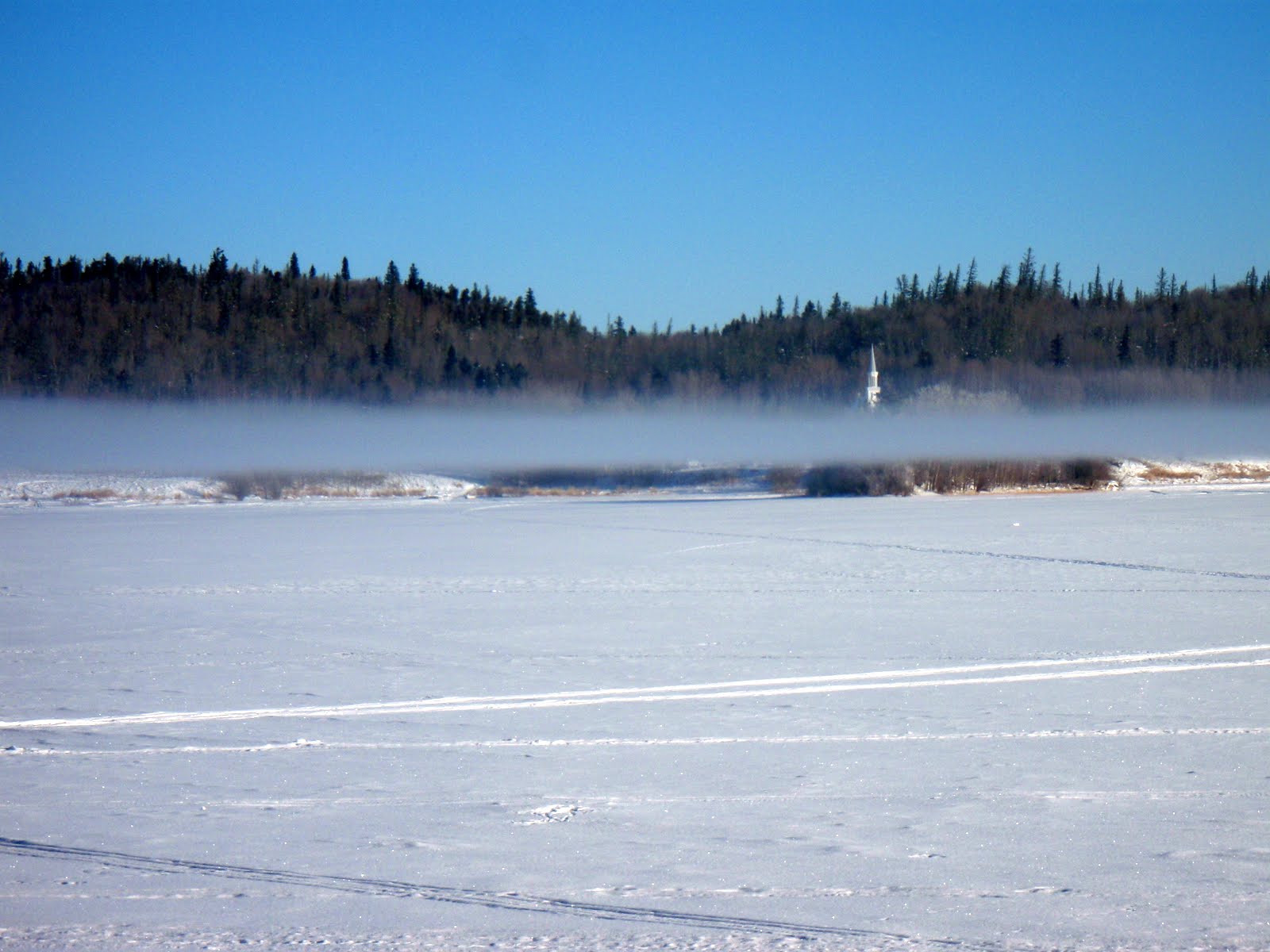
 
Fog in front of the church at Stanley Mission. Mark & Zoe's photo.

Me, setting out with my loaded toboggan. Mark & Zoe's photo.
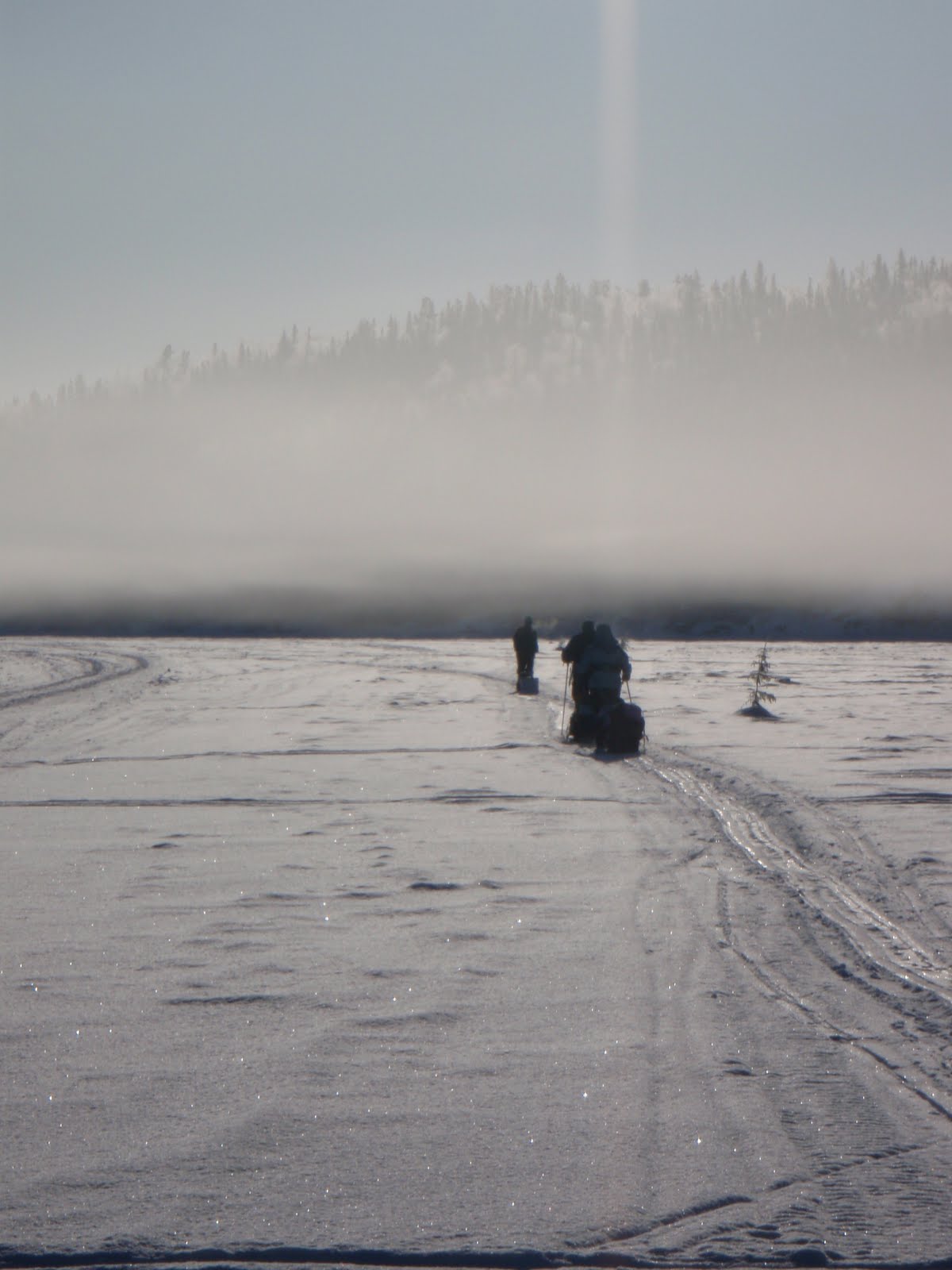
Following the skidoo trail away from Stanley and under ribbons of fog. Mark & Zoe's photo.

This trip was my first one using my new UHMW (ultra high molecular weight polyethylene) plastic toboggan. Made from a 1/4" thick, 10' by 16" piece of plastic, there is a little about 9' of loadable space behind the front curl. Unlike the pulks of the others which are being towed by ropes through metal or plastic conduit as poles and connected to a harness, I used rope. I connected the rope via small carabiners to a beefy fanny pack that doubles as harness, or to a 36"' length of 2" webbing (a tump). The webbing strap could be positioned in any of a variety of ways, including across my chest or over one shoulder and down to my side and is a more traditional way to pull this high tech old-fashioned toboggan. When using the fanny pack, I had my hands free to use ski poles to help myself push up the hills. However, when going up one steep section, the buckle of the pack came apart and the 140 pound sled slid backwards down the hill, nearly taking out Bob in the process.

Loaded toboggan parked just off trail during a snack break.

As seen in the previous photo, my load had a milk crate at the bow, two duffel bags amidships, then the stove and a grub box (wannigan) at the stern. The milk crate served as a sort of "glove box" for the sled - a place I could toss loose items and keep spare mitts, a shell, snacks, coffee and water handy. However, being open topped, it's easy to lose items and I think some sort of easy to access lid may be better. The duffels are narrow enough not to overhang the sides, one containing my clothing and sleeping bags, the other containing miscellaneous camping gear. The stove contains the stove pipe and legs inside and the bungees holding the stove down are also holding the extra pieces of elbow. Finally, the grub box contains most of the food for two of us and also had enough room to contain my extra boots. My small shovel is strapped on top and an extra sweater is tucked under the bungee cords. The load is secured with bungee cords across each section, and a rope zigzags across the duffels to help ensure their sides don't overhang the sled. One major advantage of this system is the load height. My load was mostly under 12" tall, and whatever extended above 12" was very light (that grub box on the back was only 3/4 full). That means it's stable and does not easily tip when going over an obstacle. Also, the undulating nature of the sled allowed it to climb over obstacles one section at a time while the remainder of the sled remained fairly flat on the ground. This is in contrast to some of the other sleds which were shorter and piled much higher.

The first leg of our route out of (and into) Stanley Mission as recorded by GPS, click for a larger image. The purple line is actually from our way out, with the white lines being what was recorded on the way in. I was using regular and weak AA batteries initially and the GPS did not start working consistently until those were swapped for fresh lithium batteries.

Our path followed a skidoo trail away from the Churchill River overland for 10 km to Iskwatikan Lake, crossing a handful of small lakes (the largest being Bow Lake), sloughs and beaver ponds along the way. The path was usually fairly narrow, about one snowmobile wide, and was well travelled. Occasionally we were overtaken or met a snowmobile on the trail which required that we make haste and get off the trail in a hurry. My toboggan was sometimes difficult to get off of the trail quickly and required a certain amount of clear space in the bush into which I could head into. However, off trail, the sled handled and negotiated surprisingly well through the underbrush and between the trees.

The hills on our route were generally short and steep, with the trail undulating over ridges. However, there were a few brutal long, though not overly steep, sections to climb. It was going up those hills that I really noticed the weight on my sled (later weighed and approximated to be 140 pounds, about 60 pounds higher than anyone else!). This being my first time using the new toboggan, it took me some time to really learn to drive it. There are some skills involved, especially for managing the downhills. When towing with my arms wrapped behind me in the ropes, I found that they work as a sort of shock absorber allowing me to take up some of the slack when the sled was catching up to me, and to absorb the shock when the sled slowed. Also, when the toboggan ran downhill, it would run over it's ropes which would then act as a brake and usually keep the sled from catching up to me. For other downhills I found that by holding the tow ropes and the stern rope at the same time, I could walk the sled downhill, much like lining a canoe down a rapid. I was also able to walk the sled downhill from behind while holding onto the towing ropes (which is why I had made the ropes over 10 feet long so that they would reach all the way from the bow to behind the sled).

 Walking the sled downhill ahead of me.

Another look at the toboggan. There is a short rope on the front allowing something to grab other than the long towing ropes when desired. There are also a pair of eye bolts attached to u-bolts that go through the tow bar. The eye bolts are attachment points for rigid poles similar to that used on my pulks, as system I wanted to try out but I forgot the poles at home. The eye bolts are fitted into a short piece of garden hose to keep them from dangling down.

A short video of me learning what happens on the short steep hills when the sled abruptly stops, but I don't.

Second leg of our route into Iskwatikan Lake and our campsite (click for a larger version). There were was a high ridge to cross to reach the lake.

Elevation profile of the route as generated by MapSource v. 6.15. 

Elevation profile recorded by the GPS. This is after some of the most obviously out of whack points have been cleaned up, but a couple remain. 

 
Bryan, Mark, Bob, Zoe, Mike & Laurie enjoying the sunshine after arriving on Iskwatikan Lake. This photo was taken for us by a Stanley Mission family that also stopped for a rest en route by skidoo to their cabin, another 58km farther. Mark & Zoe's photo.

After travelling along the shore of Iskwatikan Lake for about two kilometers we found a place along shore that looked promising for a camp. The spot we eventually settled on was back a bit from the shore, tucked into the black spruce in a spot that would have been horribly buggy and damp in the summer. However, in the winter it serves just fine.

Our evening around the fire was a tad cool as the temperatures never did get very warm that day (in contrast with the forecast) and the evening temperatures were around -25C. It was off to bed relatively early since it would be another early morning the next day. Mike & I retired to the hot tent and got the stove going again (we had it running earlier in the evening for a while after camp was set up) while we prepared for bed.
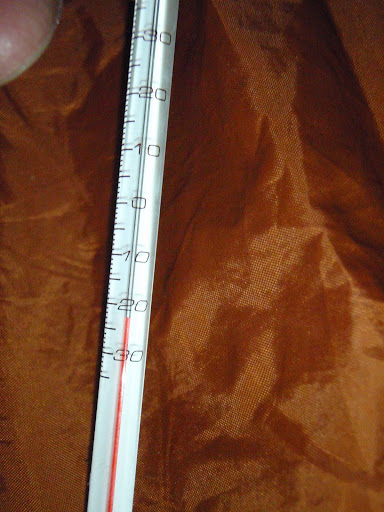
Mark's thermometer at some point in the first evening. Mark & Zoe's photo.

My sleeping system included a thermarest pad with a shorter foam pad underneath (and a layer of spruce boughs), a -12C MEC bag, a MEC overbag, and a vapour barrier liner. The  latter was being used for the first time. I've brought it along a number of times but never felt it was cold enough to warrant it's use. I've also been somewhat put off by the thought of sleeping inside a non-breathable plastic bag which surely must feel damp and clammy. I wore Stanfield superwash wool long undies, thin merino wool liner socks, and a toque to bed and not only was it not clammy and damp, but I was comfortably warm all night. Except my face; that did get cold and I rectified it sometime in the night or early morning by pulling on a fleece hood & face covering.

We awoke to -30C temperatures so I quickly (no, make that 'reluctantly') set about getting the fire ready. Unfortunately, we didn't have a lot of firewood and kindling ready to go, so I found myself scrambling for wood and snapping branches into shorter pieces of kindling, and gathering my fire lighting supplies. I then learned that my lighter would not work at -30, it was too cold. Switching to matches, I could not find anywhere to strike my "strike anywhere" matches. The stove was too new to have any rust or rough spots, and we were sleeping on a bed of moss and snow covered in pine boughs, not a rock anywhere. Of course, striking one match against the other always works, but by now I had lost all dexterity in my cold hands and I could not manage to get better than sparks before wrecking the heads. With thoughts of the Jack London "To Build a Fire" story in mind, I switched back to the lighter which I had been sitting on in the meantime in order to warm it. Thankfully, this time it worked and I was able to get the stove lit, but not before becoming quite chilled. I returned to the sleeping bag while I waited for the tent to warm with the fire and while listening to Mark getting the main campfire going outside.
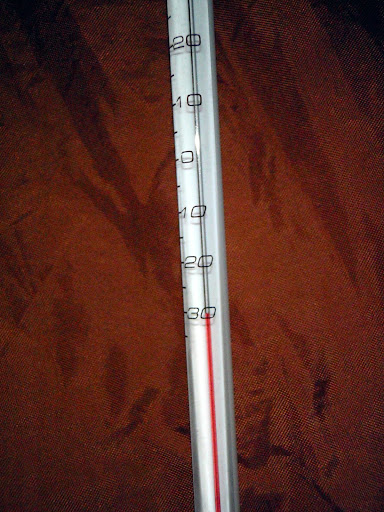
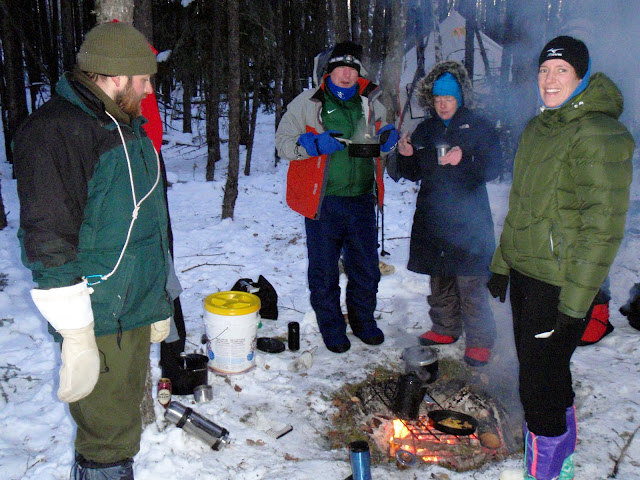
Breakfast by the campfire. Mark & Zoe's photos.


Our plan was for a quick breakfast before hitting the trail, but camp duties take longer in the cold and some got quite cold in the early morning hours. Also, some had a cold night with sleeping systems that were insufficient at minus 30. Eventually we did get underway and those that were chilled could begin warming themselves through activity.
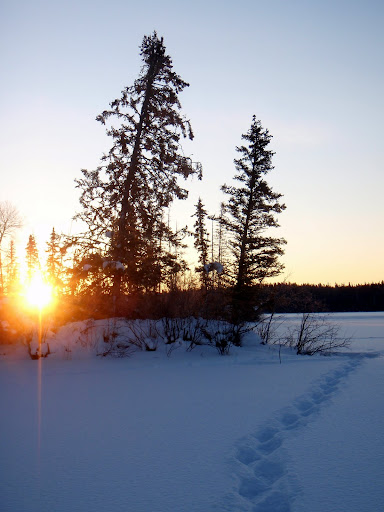
Sunrise near camp. Mark & Zoe's photo.

The falls were 8 km away from our camp and we followed the skidoo trails on Nistowiak Lake. At one point there are a couple of islands that one must go between so we exercised a fair degree of caution in that area. Although we were on a lake, it is part of the Rapid River there is potential for current around points and between islands. We spread our group out so that no more than one person could run into trouble at once. We also carried ropes or throw bags to assist in a rescue form the water if need be. Thirdly, we stuck to the snowmobile trails where others had passed safely before us. The snowmobiles pack the snow and decrease it's insulative value allowing the ice to freeze more thickly.

Once in the vicinity of the falls, we followed the trail inland. This trail starts well above where the river exits the lake, unlike the usual canoe portage. We toured down to the first rapid that marks where Iskwatikan Lake spills into the Rapid River, then continued on to the top of the main waterfall. There, we found ourselves in awe. The waterfall plummets 10m and in doing so throws up a large amount of spray. In the winter cold that spray freezes to everything it touches and as a result the scenery of the waterfall is an ice-covered wonder. The sheer quantities of ice that entombed the trees was incredible. The colours of the ice, and the rainbows in the bright winter sun were visually impressive. At the moment that each person reached the top of the falls they knew the cold and long trek was worth it. A written description and even photos won't really do it justice, you are just going to have to take a trip there for yourself.

 Mike looking out toward Iskwatikan Lake from the top of the first rapid.

The first rapid exiting Nistowiak Lake, about 300 m above Nistowiak Falls.


The pool below the first drop and above Nistowiak Falls.

 Zoe enjoying the scenery of the first rapid.

 Mark heading back out on the trail toward Nistowiak Falls.

 En route to the falls.


 Looking back toward the first rapid while en route to the falls.

 There was some confusion over which way to go (which led to our side trip to the top rapids). But, being skilled and experienced woodsmen, we were able to read the signs of nature to find our way.


Mark, Zoe, Mike & Laurie take in the scenery at the falls.

Some of the huge masses of ice formed by the spray being thrown up onto the trees and rocks. 


The first drop of the falls.


Rainbows in the sunshine.


Mike absorbing the spectacle.


Mark heads down toward another vantage point. 


Lunch above the falls.

We spent about an hour at the waterfall, taking in the scenery, basking in the sunshine, and eating a frozen lunch. We did not explore down to the bottom of the falls, or Fissher Rapids below, and being concerned about getting back to camp with a wide margin of remaining daylight, we got back on the trail across Iskwatikan Lake. The temperatures for the return trip had warmed up to about -15C and we had a slight tail wind, very nice travelling conditions. We were heading into the declining sun and I was glad to have my goggles with me. In fact, several folks developed a good sun tan on the trip and my wife commented later that I had a lot more freckles. Sunblock would have been warranted given the amount of light that was being reflected off of the white world around us.


 Brilliant sunshine and sundogs.

Bob and Mark lead the way.

 Some of the Iskwatikan Lake geography.

 Mike and Laurie. Laurie must be finally warm - no toque or mitts!

 Heading toward a narrows between the islands.

 The group spreading out for safer ice travel. 


Mike. Mark & Zoe's photo.

 Mark & Zoe and a valentine's message.
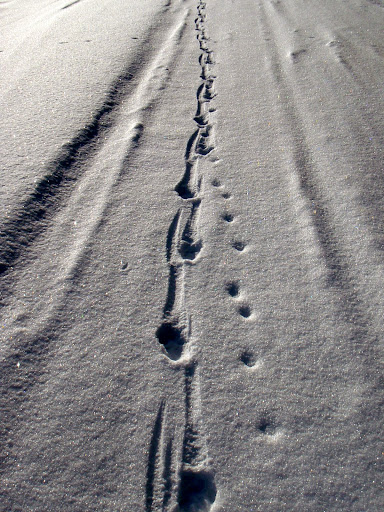
Wolf tracks near camp. Mark & Zoe's photo.
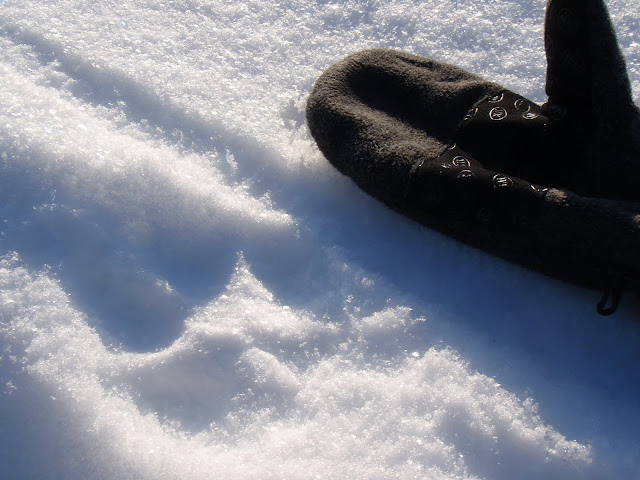

Mark & Zoe's photo.

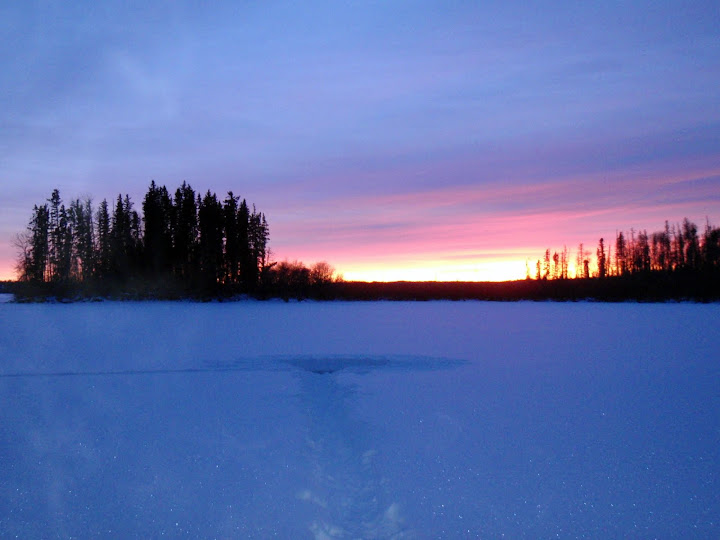
Back at camp on our second evening we endeavoured to put up a lot more wood in order to be better prepared for both evening fires and for the coming morning. Zoe sawed and sawed and sawed. The rest of us collected, dragged and split, spelling Zoe off the saw for short stints. Mike & I also collected a bunch more spruce boughs in order to improve our bedding in the tent. We enjoyed a beautiful evening in camp with a gorgeous sunset and I think the temperatures actually continued to rise a bit. Mark noted that he thought the weather had turned (for the better) and he would later be proven correct.

 Mark & Zoe's tent.

 Setting sunlight on the trees.


Sunset over the water hole. Mark & Zoe's photo.

 Bob by the campfire with a gorgeous sky beyond.

 Laurie dressed to stay warm while relaxing by the fire.

 Mark & Bob tend to their suppers while discussing the best methods for thawing frozen wine and why glass bottles of wine are not ideal.

 Valentine's evening at camp.


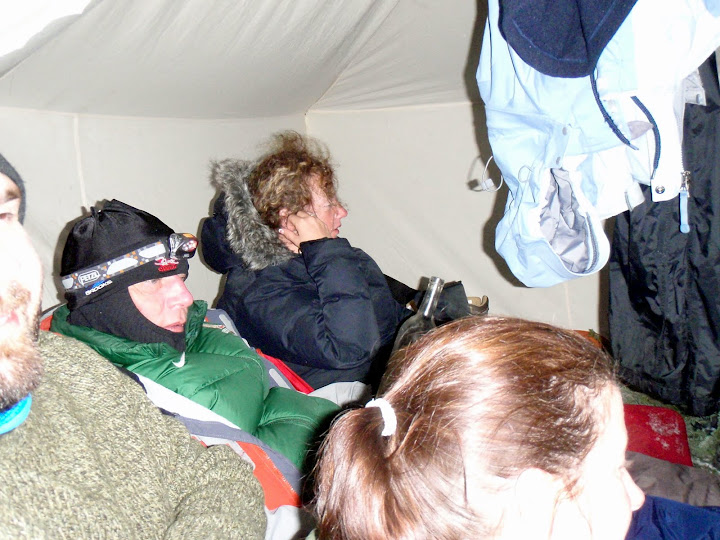
After supper by the fire, we retired to an evening in the hot tent with the stove burning, something we should perhaps have done the previous evening when the temperatures were much lower. The tent easily accommodates 6 relaxing folks.



Because of the cold earlier in the trip we had decided to pack up and head out on our third day, originally planned as a day to relax or explore near camp. That was decision was made in the cold of the second day, and I think some were relieved. There was concern it seems over how some would keep warm during the relative inactivity of our rest day. So, it was another early morning the next day in order to break camp and get started on the long haul out. Our second morning broke much warmer than the previous one and life in camp was pretty comfortable. After packing everything up and loading the sleds, we struck out on our return to Stanley Mission.

Making a few adjustments before leaving Nistowiak Lake and entering the overland skidoo trail to Stanley.

The return trip was nearly as hard as the trek in, but the weather was sunny, calm and pleasant. The temperatures were certainly climbing. We were in a bit of a hurry to ensure we made it back at a reasonable hour in order to pick up our vehicles from the police station. Once we got out in the open near the town of Stanley Mission we became aware of a stiff breeze blowing.

Some of the exposed shield capped in snow.

 A look at the trail.

 A lunch break of tea and gorp in a sunny spot en route.

 Emerging from the trail into a bay near Stanley Mission.


 Our trail passed a bit less than 1km south of the Holy Trinity Anglican Church.


Open water of the Churchill River near Stanley Mission. Amachęwęspimawin Cliff is in the background.

After retrieving our vehicles from the police station and loading everything in, we began the long drive home. The drive was uneventful, except that Mike was feeling the full effect of flu-like symptoms he began to feel on the trail. Thankfully, there were no unexpected stops on the side of the road to account for this. I did make one extra stop in an effort to help some folks change their tire on their half-ton. It was one with the spare stored underneath the vehicle and released by inserting a crank and turning to lower the cable. Unfortunately, something was stuck or broken because nothing I could do helped. It was about then that the lady mentioned none of the previous 6 guys that stopped had any luck either. Thankfully, a tow truck from La Ronge arrived about the time I was leaving.

Back at home, I was generally tired as hell for the next few days, literally wiped out. My muscles were sore, but not overly so, and time in Mike's sauna may have helped alleviated some of the aches in that regard.

All in all, it was a great trip. I learned that some of my untested stuff worked very well at minus thirty, and I learned that I could withstand an arduous but adventurous trip. I still think it would have been better with the extra day in there to rest up a bit and enjoy life around camp before heading out, but I know better now what my limits might be. I have a long list of things learned from this trip, something the group all shared with each other by e-mail after the trip. I'll re-format and paste the list in as a post of it's own.

Our complete route in and out from Nistowiak Lake. Click on the image to view full size.

Thursday, February 25, 2010

The Good Life

It's a beautiful sunny Thursday afternoon and I'm sitting out in the background right now, enjoying a beer. It's a Kilkenny beer that I recently towed 24 km by sled on my trip to Nistowiak Falls so it's good to be enjoying it at a worthy moment (the story of that trip is coming in a post of it's own). I have the canvas tent set up in the back yard, and my daughter & I just finished a lunch of perogies and sausage, leftovers fried in a pot on the wood burning stove. At the moment it's t-shirt warm in the tent despite the half open door. Life is good.

Hot tenting in the back yard.


Cooking lunch.

A well-traveled beer to go with lunch.

St. Gregor sausage and fried Baba's perogies. Can it get any better?

My lunch mate.

Ready for dessert.


Sunlight through the trees shining as seen from inside the tent.

Thursday, January 28, 2010

This Is Canoeing

This is a trailer for a new video coming out from Cackle TV Productions. The trailer does a very good job of piquing my interest in the videos.


From the production company's web site:
“THIS IS CANOEING” is a 2-disc celebration of canoeing, showcasing top single-blade paddlers in their pursuit of remote wilderness journeys or challenging white water. Multi-award winning film maker, Justine Curgenven captures the essence of canoeing in 12 short films. From open canoe slalom races to 1,000 mile birchbark expeditions, Justine provides insights into the diversity of the sport and the influential people who tell it’s story. Immerse yourself in this globe-trotting 3 hours of adventure to world class canoeing destinations in Canada, the United States, Scotland & Wales.

FEATURING;

KEVIN CALLAN – BECKY MASON – PAUL MASON – MARK SCRIVER- ANDREW WESTWOOD - KAREN KNIGHT – BOB FOOTE – RAY GOODWIN - WENDY GRATER - CHRIS COOPER – DAVE ROSSETTER – ELI HELBERT - JOHN ‘KAZ’ KAZIMIERCZYK – HAILEY THOMPSON – CAROLYN PETERSON
You can pre-order your copy of the videos at the Cackle TV web site. There is also more information about the videos, including information on the featured paddlers and the waters they are paddling.

Wednesday, January 13, 2010

Forecast For A Winter Trek


I'm heading with a group for an overnight snowshoe and camping trip to Prince Albert National Park this weekend. The forecast is for pretty mild weather, but we're still a few days out so there's room for change. Let's have a look at what the two main forecasters are predicting for the area for the weekend. I'll revisit this next week, after we come back.

I've taken screenshots from the website of both forecasters (just after 5 pm), cropped and rearranged them a bit, and posted them here.

First, the forecast provided at www.weathernetwork.com:


And now, the same from Environment Canada at www.weatheroffice.gc.ca:


So that's the forecast, lets see what reality brings....

Sunday, January 10, 2010

Keep My Fingers Away From That Blade

Many of us that work with table saws and wood have heard of the SawStop over recent years. It's a table saw that can sense when it's no longer cutting just wood, but is cutting flesh, and stops it self rather dramatically to protect your hands. Most of us have seen the videos that show what happens when a wiener is used as a substitute for a human finger to demo the SawStop. However, this was a new take on the demo video for me. Watch the video, it's worth a few minutes to see.


Saturday, January 09, 2010

Winter Camping Gear List

This is an attempt to publish my winter camping gear list which I use Google Docs to keep in a spreadsheet format. You can view the real version here, where it should appear as a normal spreadsheet and will be kept up to date. I'm getting ready to head out on a couple of trips this winter so I've been getting my list in order.

Note that one could write a book chapter on some of the items on this list such as sleds, boots, tents, etc.


Individual Item
Group Item
Comments

Cooking

Stove
X
1 per 4 people

Matches & lighters
X
Everyone should have a few fire starting methods on hand, all the time

Fuel
X

Fire starter
X
X

Cooking grate/bars
X

Gloves
X
Leather gloves for handling pots, and working the fire.

Pots
X

Pot lifter
X

Spatula
X

Dish soap
X
Warm in a pot of the warmed dishwater to use. For dishes - you may just scrape pots with snow to clean them.

Pot scrubber
X

Dish towel
X

Food pails
X

Cutting board
X
can use lid of the food pail

Tinfoil
X

Thermos
X
1 per two people, can be used for hot drinks on the trail, have something hot and ready for the morning, etc.

Cutlery
X

Plate/Bowl
X

Insulated mug


Camp Gear

Tent
X
Included as individual item since each person needs to make sure they have shelter

Ground sheet
X

Axe
X
1 per 4 people, sharpened. Also useful for getting water through ice.

Folding saw
X
1 or 2 per 4 people

Tarps
X

Rope
X

Snow shovel
X
1 per 1 or 2 people

Sleeping Bag System
X
Cold-weather bag suitable for the coldest weather. Could be a -12C bag plus an overbag, vapour barrier liner, fleece liner, etc.

Sleeping pad
X
it's a good idea to double these up or use a shorter foam pad under a thermarest

Big duffels/packs
X

Duct tape
X

Lantern
X
Good item for a group - it gets dark early so most cooking and many camp activities sill be done int the dark

Flashlight or headlamp
X
If using a metal light - wrap end in duct tape if you are like me and occasionally use your mouth as 3rd hand to hold it. I usually bring a headlamp and a maglight with spare batteries for each.

Maps
X
1 full maps set per - or two people.

Compass
X
Know how to use it.

GPS
X
Does not replace compass and real maps.

Plastic bags
X

First aid kit
X
Kit sized for the group, multiple kits is better.

Multitool &/or knife
X
I bring one of each.

Toiletries
X
Don't bother with deoderant and toothpaste - it doesn't work well frozen.

Toilet Paper
X

Sunscreen
X

Emergency blanket
X


Transportation:

Snowshoes
X
Bring shoes appropriate for the conditions. If weight is not a major concern, I'll bring a smaller pair for camp/bush use

Skis
X
I might also bring both skis & snowshoes, but usually just snowshoes now.

Ski Poles
X
Even if snowshoeing, poles can be helpful.

Sled/Pulk
X
Ideally with poles and some sort of harness system to help with hilly terrain.


Personal Optional Gear

Camera/tripod
X

Binoculars
X

Chair
X
Dependant on space/weight limitations, but some sort of device to sit on is good.

Small foamie
X
For sitting on, kneeling on, standing on when changing footwear, etc.

Notepad & Pencil
X

Alcohol
X
Dependant on space & weight. Remember alcohol decreases cold tolerance.

Medications/pain killers
X


Clothing Stuff:

Boot System
Winter boots with removable liners or whatever is going to work for you. Need something for trekking & also camp work, and evening use.

Camp booties

Heavy socks
1 or 2 pair

Midweight socks
2 pair

Liner socks
Polypro or whatever

Vapour Barrier Liners
aka plastic bread bags to keep your feet from sweating up your boots, unless your boots breath or you can dry them out at night

Jacket/Parka System
Breathable shell & insulating layers, might be a separate parka for sitting around the fire and in the morning, or it might just be more layers. Anorak shells with a fur-ruffed hood are very popular.

Sweaters
I like wool. Multiple layers is good with a thin sweater and a thicker sweater

Pants
I like a good camping pant with lots of pockets

Wool/fleece pants
Insulating layer

Shell pants

Long undies (top & bottom)
2 pair of bottoms, a dry pair to put on in the evening and a pair for when sweating

Underwear

Scarf
Scarf is the equivalent of Arthur Dent's towel.

Neck Tube

Toque
I bring a thick wool toque and a thinner toque.

Mitts & gloves
I bring a few options


Polypro liner gloves

Wool liner gloves

Overmitts/Shell mitts

Balaclava

Ski goggles/sunglasses
It's bright out there and you will damage your eyes without GOOD protection.


Monday, December 21, 2009

Snowshoe Building Videos

I recently came across this series of videos taken during a snowshoe building workshop. The video was filmed in Stanley Mission (near where I paddle and where I hope to head off on a snowshoe trip later this winter) and the language used throughout is most likely Cree. An interesting look at building simple snowshoes (of the same type as mine) using only hand tools. These folks start right from the log and go through the whole frame building process. Despite any language barriers, the videos are very interesting and sufficient to figure out how to build the frames (more or less), but the lacing would require a much more in depth look for me to understand it.

The whole website is interesting, showing numerous aspects of Dene and Cree culture, including language and crafts such as birchbark basket making.


Link to the videos at the Gift of Language and Culture web site here.


Thursday, December 10, 2009

An Experience In Bacon

A couple of months ago I posted my discovery of something called a "Bacon Explosion". A couple of weeks ago I finally was able to make my version of the recipe as my contribution to the put-luck supper at a Grey Cup party.

A "Bacon Explosion" is a meat creation comprised of bacon and sausage meat, where the sausage meat is surrounded in a woven wrap of bacon and the bacon and sausage rolled together. The meat is then smoked and slow cooked. There are as many variations on this theme as there are folks that have made it, with various fillings used, and a variety of spices or sauces. Further, the type and degree of smoke can also be varied.

For my version I decided to use a filling of bacon, onions, red peppers and mushrooms, using inspiration provided by Dunkin'.

For my sausage meat I originally bought some frozen plastic wrapped breakfast sausage meat at the local Sobey's grocery store. They only had one 500g package though, and I needed 2 kg. So, I also bought some mild Italian sausage in casings from Superstore. After cooking up a bit of the meat from Sobey's, I'm glad they didn't have more of it as I found it to be very salty & very fatty. The Italian sausage, thankfully, was neither. Below, the sausage meat has been stripped from it's casings and the first few slices of bacon fried up and chopped for use in the filling:

Some nice, healthy vegetables for the filling:

I should have taken a couple pictures prior to this next step. The bacon was laid out in a mat and woven together as per the instructions at the BBQ Addicts web site. On that woven bacon I sprinkled some rub that I had on hand. On top of the bacon I laid the sausage meat, forming the meat into a thin layer. The meat was not formed as one thin sheet and laid on top, but rather pressed into place piece by piece. I think that approach led to the cooked product not holding together well. I should have rolled it out into a layer, then somehow transferred it into place. The next layer was the chopped bacon and cooked vegetables.


The filling was seasoned with more of the rub and a generous amount of President's Choice Chipotle BBQ sauce (really decent stuff, by the way).


I should have had a photographer present during the rolling process. I rolled up the stack of layers, trying to keep everything as tight as possible.Getting the thing to roll up and keeping all the filling inside was easier said than done, but the next one should go better (not that this one went badly).

Below, I'm adding more of the rub seasoning:

A couple of hours in advance of the Grey Cup game, I brought the smoker over to Rob's place and set up in the back yard. A tarp was set up to protect the smoker from the wind, and a thin blanket wrapped around the smoker to help get the temperature up in the cool weather. The meat was smoked with maple wood at about 225°F.

After 4 hours of smoking, the Bacon Explosion is ready to come out at half-time.


Ready to eat:

Below, a picture of me slicing up my contribution to the potluck supper:

The creation was very tasty. In fact, we were so busy eating that no one could take a picture of us enjoying it. It was not as fatty as I might have expected. Slow cooking at those temperatures (200 - 250 F) melted a lot of the fat out of the meat. It did shrink a certain amount and firmed up. In the future, I'll try to make sure it is rolled tighter and that sausage meat is better consolidated so that it holds together better during the slicing.
Posted by Picasa

Monday, December 07, 2009

Paul Quarrington

Author, screenwriter, and folk/blues musician, Paul Quarrington is dying of cancer. Quarrington's book, Fishing With My Old Guy is one of my favourites and I've enjoyed several of his other books as well, such as Whale Music and King Leary. I have thought that someday I'd like to spend time fishing with Paul Quarrington and David Carpenter, both literary fishermen (and not ones of the large-boat catch-your-limit-fast sort). Today over lunch I read his latest article for the National Post, the second instalment in his "Cancer Diary". Quarrington continues to be a very gifted person and this article is another fine example. He struggles to remain with us for a while longer, and for that we should be thankful.


January 21st, 2010 Update: Paul Quarrington's journey with cancer ended today. To quote from paulquarrington.org:
His brave battle ended on January 21, 2010.  He passed peacefully at home in Toronto in the early hours surrounded by friends and family. It is comforting to know that he didn’t suffer; he was calm and quiet holding hands with those who were closest to him.

Contributions to the Quarrington Arts Society are being accepted in his honour; visit http://www.quarringtonartsociety.ca

Rules of Winter Cycling

It was -31°C with a -40°C windchill (9 km/hr head wind) this morning. It took me an hour to get the kids to school and the sitter, then in to work. Never mind the amount of time it took to get suited up this morning (and to figure out my 'system' anew this year). I guess my winter cycling season is officially here.


Three Golden Rules of Winter Cycling:
  1. No Whining
  2. No Whining
  3. No Whining


Saturday, December 05, 2009

Ray Mears, Northern Wilderness

I've been aware of Ray Mears for a while now, having heard of him described as Britain's version of Les Stroud, Survivorman. However, I'd never seen any of his videos and after having seen the abomination that is Bear Grylls, another person that gets compared to Stroud, I really didn't care to look much further. However, the Ray Mears documentaries for the BBC were recently recommended to me, and it was mentioned that an episode was filmed in nearby Prince Albert National Park. Well, today I found that video on YouTube (in 6 parts), which I believe is the first in a series.

I am embedding the video here, but if you have the bandwidth, watch it full screen in the highest quality. The full video is about 60 minutes long, but is broken up into 10 minutes segments for YouTube. To see all of the video clips in order, go to the playlist found here. The clips played automatically for me, one after another in order. The production and videography is excellent. The interest, information, and entertainment value are also very high, in my opinion. The focus, at least in this first episode, is not so much on skills or wilderness techniques described, but on the ecology of the boreal forest.


I watched the "Forgotten Forest" episode this afternoon (somewhat accidentally - I didn't mean to watch the whole thing). This evening I watched it again with my wife, at least the 2/3 until she fell asleep, it being past her bedtime. The Forgotten Forest episode was filmed in Prince Albert National Park (PANP), my familiar trekking and paddling grounds. I was able to recognise some of the places shown in the film, just this summer swimming and playing on the beach where he had the small fire with the jack pine cones in the film (I'm about 70% certain on his location). It is great that the park was shown in fall and winter, the seasons I like best in the park. I've been to Grey Owl's cabin on Ajawaan Lake about 6 or 7 times, by foot, snowshoe, canoe & kayak. This summer I brought my kids up to the cabin. It was also very interesting to see him putting into practice the use of the Black River sled, the Snowtrekker tent, and small wood stove. Also, the jacket Mears is wearing is not a parka as it may first appear, but an uninsulated shell cotton anorak, much like that made by Empire Canvas Works. A cotton shell would be breathable, shed the snow, and not tear or burn as readily as gore-tex or synthetic material shells (which work poorly in freezing temperatures).

It's interesting to learn a few more things about my own back yard from a Brit. Ray Mears conveys a great deal of respect and a sense of awe towards something that most folks around here take very much for granted.

The ecologist that is featured during this episode is J. David Henry. His cold-weather clothing looks like something from a MEC catalogue, circa 1986, but obviously it's still working for him after 20+ years. (As an aside, I wonder how much of their current product line will still be in use after another 20 or more years?) His mitts look very much like my MEC over-mitts, but in flashier colours. Henry co-authored a chapter in the book Endangered Spaces titled "Misunderstanding the Prairies." The biography of Henry in my copy of the book, published in 1989, describes Henry as a biology professor in Regina and as a key player in the revision of the National Parks Act and the establishment of Grasslands National Park.

The woman teaching the birch bark biting was Sally Milne a Cree elder from La Ronge. You can find out more about her here: http://www.virtualsk.com/current_issue/culture_and_spirit.html

Tuesday, December 01, 2009

13th Man

It's either laugh or cry. I'm still leaning toward the latter. Perhaps some day I'll be able to see the humour.


Oh, what could have been...